Showing posts with label Superman. Show all posts

Friday, September 8, 2017

What We Mean When We Say “Super Hero Fatigue”


Nothing quite sets me off like the phrase “Super Hero Fatigue.” It’s a passive-aggressive way for movie reviewers and online content providers to turn their nose up at a genre that they either don’t like, don’t get, or some combination of the two. I’m not unsympathetic; we’ve all gotten fed up with a trend or a fad before the media, or your little sister, or the world was ready to let go of it, and we’ve all suffered through “the Spring Break song” of the year or the Twilight Saga or whatever it was with a mixture of benign hate and stoic indifference. I get it.


But if you don’t stop talking about super hero fatigue, I’m going to sock your nose. 


When you talk about “super hero fatigue” you may mean that you’re bored with the movies, but what I hear when you say that is, “I want these movies to go away.” Well, I don’t. If you don’t like them—if they aren’t for you—that’s fine, whatever, go peddle your ducks elsewhere. But to my mind, they’ve only really been good for, what, 9 years, now? Not even a full decade? Why do you hate fun? Who hurt you? And why would you waste good ink complaining about it when there’s hundreds of other movies, obscure and neglected, that you can champion as only a hipster can?


Now that you know what this blog post is going to be about, feel free to chalk it up as one of those “Old Man Yells at Cloud” posts. Or just skip right down to the end and tell me I don’t know what I’m talking about. You will be wrong, of course, and do you know why?


I did the math. I’ve got the numbers. I have data, you smug bastards. So let me explain to you folks—many of whom are under the age of 35—why you need to stop kvetching about the Super Hero Movie Genre and let us Generation X folks have our moment.


My Thesis
The modern comic book movie didn’t officially begin until the year 1999 with the premiere of The Matrix. While it was not connected to a comic series or based on established characters, the visual effects in the film handily duplicated the fast-action and ballet-like fighting that was a staple of comic books. The “Bullet Time” effects in particular showcased key scenes before, during and after their execution, mimicking a “panel” in a comic.


Note: I did not include Blade (1998) in this calculation because, while Blade’s comic book origins are well-established, he is a vampire who hunts vampires. His speed and strength did not need any further explanation. The movie going audience understood that from the get-go and so no additional story was needed to justify his “super powers.” Nevertheless, Blade does count as a comic book movie, as we’ll later see.


Special effects, and in particular computer-generated effects, have been a staple of the movie industry since Jurassic Park in 1993. However, it took nearly a decade to create computer-generated imagery that was able to meet the rigorous demands of a super hero film. Even movies that were deemed mediocre as films boasted incredible special effects and images that were simply not possible prior to the 21st century.


Of course, that didn’t keep Hollywood from trying. The 20th century has some of the best-and worst-super hero movies and television shows to ever exist. And I should know. I watched all of it. Yeah, that’s right, all of it. Look, I was an early and avid fan of super heroes. I was reading comics at the age of 5. Collecting them by age 8. And—here’s the kicker—I was born in 1969, which puts me at ground zero for everything that was to come along and, little by little, improve with each try. In fact, I’ll go so far as to say that if you were born anytime after 1960, then you probably feel as I do, if you’re as big a fan of comics and super heroes as me. If you were born in the seventies, you’re probably on board with me. But if you were born in the mid to late 1980s...you may just be the person I’m talking to when I say, “shut up your flapping food hole” about Super Hero fatigue.


I Made a Chart
You can download a PDF of my full chart here.  It took me a while to put together, since this is not my strong suit. But I wanted to back up my feelings, my impressions, and my memories with some actual hard data points. So there it is, in its full glory, if you’re so inclined. Also, I graded every single super hero movie and project from A to F. That's what we're all going to fight about. I just know it. So go ahead and download it now and look it over and get ready to tell me why I'm the biggest idiot the world has ever produced because I didn't like your favorite movie from 1997. For the rest of you, I’m going to skip ahead and talk briefly about what I uncovered.


Most of you know that modern super heroes debuted in 1938 with the first appearance of Superman in Action Comics. Batman followed in 1939, and Captain America and Wonder Woman came after that in 1940. Most of you know about the Golden Age of Super Hero Comics, and you may even know about the Silver Age and the creation of Marvel Comics in 1961 with The Fantastic Four, followed quickly by The Incredible Hulk and Spider-Man.  


Marvel and DC continue to rule the roost when it comes to super heroes and their related properties. There have been (and continue to be) other publishers of comics, but it’s hard to topple characters who’ve been around for 60, 70, and 80 or more years. One thing I found interesting was that the 1940s and the 1960s, both times of great interest in comic book super heroes, each had their own attempts to capitalize on that success in movies or TV.


The 1940s were the era of the serials, or “Cliffhangers,” wherein a story was broken up into weekly chapters, each running around 15 minutes, and exhibited as part of a larger Saturday matinee program. These serials were sometimes re-edited into feature length films. The special effects for these cliffhangers was shoestring, at best, but the stunt work and action were often top-notch.


The 1950s gave rise to atomic age science fiction, and also opened up circuit distribution for independent film companies and “packagers.” Thus, quality varied widely, with some of the movies skirting the edge of outright exploitation.


Television was a fixture in the 1960s, and when Marvel came along, it saw an opportunity not on the silver screen but on the little screen. As early as 1966, a number of animated properties were developed—aimed at kids, of course—featuring the Marvel super heroes. The 1960s also continued the Science Fiction trend, but new fears were creeping into the zeitgeist. Planet of the Apes is the standout from this decade. Also, the studio system was breaking down.


The 1970s were essentially the end of the 1960s. Some speculative films were out, but there were more Godzilla movies than super hero fare on the big screen. It wasn’t until Star Wars changed the game in terms of what could be done onscreen that things started to change—but not until the 1980s. However, Marvel—perhaps emboldened by its success with animated properties, made the bewildering decision to take some of its beloved characters and turn them into lackluster live-action properties. Only Donner's Superman (starring Christopher Reeve) in 1978 could save us from such mediocrity, and set the bar so high that it became the standard for decades on How to Make a Super Hero Movie.  


1980s were a heyday for fantasy films, embracing the new technologies created by ILM such as blue screen technology and optical compositing as soon as it was invented. Most of the time, the technology was badly applied, or worse, applied quite well to bolster terrible films. Marvel never really got its legs under it, doubling down on projects like Incredible Hulk TV movies and trying to launch David Hasselhoff as Nick Fury. DC didn’t do much better, with the Superman films rapidly declining in quality, each one dumber than the last. Again, a last minute save by Tim Burton invigorated Batman for a new generation. 


Never forget. This is why we fight.

The 1990s tried their hardest to deliver, but the technology was just out of reach of the subject matter. To make matters worse, decades of bad super heroes, campy super heroes, and corny super heroes had muddied the waters. The nadir of this era was the much maligned and rightly so Batman and Robin, an intentional salute and celebration of the 1966 Batman TV show that everyone tried so hard to overcome. That the show has found a new audience now is not the point; there are finally enough interpretations of Batman in the zeitgeist that a super silly Batman isn't the only thing drawing water, nor is it the only view of super heroes out there. Back when it was the only note anyone could blow on a horn, it was tiresome in the extreme. The independent comics produced a  few exceptions, such as The Mask, which made the rubbery computer animation work for it, and The Rocketeer, which matched nice special effects with a sincere attempt at getting the character right, made the failures around it that much worse. Only the quantum leap forward with CGI at the end of the decade made what came next possible.


The 2000s can inarguably be considered the new Golden Age of comic book movies, now that technology finally caught up to the rigorous demands of the stories being told. However, the old modes of storytelling and the insistence on telling the same kind of super hero story—now a mash-up of the Superman (1978) and Batman (1989) plot would continue to plague many of the projects for most of the decade. When Iron Man started the Marvel Cinematic Universe in 2008, it put into place one of the most ambitious world-building and franchise building exercises ever attempted on such a large scale, and it paid off handsomely.


2010 to 2017 is not a complete decade, but I would go so far as to argue that today’s comic book movies and television shows have supplanted the comic book themselves in terms of the place they occupy in popular culture—as a mirror of the times, and also as a reaction to current events. This is especially true in the politically-charged decade of the 2010s. The success of the Marvel Cinematic Universe only highlights the ongoing struggles of Warner Brothers to get its proprietary DC Universe characters on the big screen.


My Methodology
First, I counted only the Marvel, DC, and Independent movies and TV shows that were based on actual comics. There were a couple of exceptions, as you’ll see if you look at the PDF above. Mostly for multi-media properties such as The Green Hornet, The Lone Ranger, and The Phantom. It was only a few extra numbers, as you’ll see. I also only counted TV shows once, even if they were on for multiple seasons.


I left off animation because it would have ballooned the super hero list. Also, because 95% of the animation was aimed at children. There’s a separate metric for that, in that all of that kiddie fare drove the discourse down and made super heroes infantile and their fans man-children for much of the 20th century. But that’s not what I was looking at. For what it’s worth, I did choose to count the live-action Saturday Morning Shows like Shazam! and Electra Woman and Dyna Girl. I’m nothing if not capricious.


Then I went back and counted all of the movies and TV, aimed at American audiences, that were super heroes who were not actually comic book based. This is where stuff like The Greatest American Hero (1981-83) got counted. M.A.N.T.I.S. (1995). Heroes (2006-2010). Hancock (2008). You get the idea. 


In order to give these numbers some meaning, I used the combined Fantasy and Science Fiction genres to help “classify” them, since they have, up until very recently, been considered part of that genre (well, sometimes they get placed in action/adventure, but I maintain that the special effects needed to get super heroes to work on film is equal to an F/SF film, so this was a more accurate grouping).  I looked at the number of “real” or Top Shelf (Marvel, DC, etc) movies and TV shows by decade, and compared them to the number of Non-Marvel, DC, etc. movies and also F/SF movies by decade to generate a percentage within that larger group. Here are the results of that.


Super Hero Movie Stats

YEARS

By

Decade

Marvel, DC & Indy films

Other “Super Hero” films

Other F/SF films

% BY

DECADE

1940s

14

1

37

36%

1950s

6

2

164

4%

1960s

3

1

115

2.5%

1970s

7

5

123

5%

1980s

11

7

196

5%

1990s

24

16

194

11%

2000s

33

5

190

17%

2010s

48*

4*

159*

29%*

* an ongoing statistic. Tallies are not final.


Interpreting the Data
I deliberately pushed “Other Super Hero” films into a separate category because, almost without fail, they only added to the signal to noise ratio in getting good and true representations of these characters onscreen. In retrospect, I should have included another column for animated series, as it’s very important from the 1960s on, as keeping the characters (albeit simplified) in the public eye. But what I’m driving at here is this: Condorman did nothing to sell the public on the idea that super heroes were anything other than kiddy fare, played for laughs. And that was released by Walt Disney. Captain Nice, another live-action Saturday morning Yuk-fest, was even more stupid. This all relates back to the Batman TV series, of course. It was played for laughs and it was so incredibly successful, so fast, that they couldn’t monetize it fast enough. It was a legitimate pop culture phenomenon. And because it was so successful, that’s the well Hollywood went back to for a full decade when Super Heroes came up. That’s why Doc Savage looked the way it did.


That’s not to say that the major comic book companies didn’t shoot themselves in the foot, either. For decades prior to the premiere of X-Men in 2000, Marvel comics fans groaned every time a new TV series or movie was announced, because they just Couldn’t Get It Right. Ever. In some cases, it was like they weren’t even trying. The Incredible Hulk was popular, for what it was, but it really bore no resemblance to the comics. There were no super villains, nothing to really set The Hulk in the Marvel Universe. Ferrigno in green body paint was expensive enough. And he stormed through Styrofoam walls, broke balsa wood tables, and even pushed cars around with his Hulk-like strength, but it was a far, far cry from “Hulk Smash.” Later, in the 1980s, they revived the Hulk for TV movies co-starring Thor and Daredevil, and they were the sorriest, most inane versions of the characters I’ve ever seen—and I’ve seen them all, even the pirated unreleased TV pilots and movies that have been shelved over the years because they sucked so bad.


And What about DC? They were defined by the success of Superman (1978) and Batman (1989), this is true, but no one ever brings up Swamp Thing (1981). Or the appallingly campy Legends of the Superheroes (1979) TV special, hosted by Ed McMahon. Lynda Carter’s Wonder Woman was initially as great as something with a nineteen-dollar special effects budget could be, but as quick as they could, they brought her into the modern era, where everyone wore pantsuits, and all of the aliens were from a future or a planet that used crystals and a lot of lycra. No, there’s enough blame to go around. By the 1970s, the ’66 Batman TV show was in syndication, and it was a daily dose of high camp caped crusader tomfoolery, and we all watched it, because we had no other options, but we also all wondered why Adam West and Burt Ward were nothing—at all—like the Batman and Robin in the comics. 1970’s Denny O’Neill/Neal Adams Batman was solving murders. Adam West was doing the Batusi in the What a Way to Go-Go. Talk about a disconnect.


At first glance, it sure does seem like the number of super hero projects has increased. I think it’s interesting to note that in terms of percentages, 2010 and 1940 are the closest in comparative sizes, and I think this is due to a similar rise in interest. Comics are no longer hermetic and inaccessible. Super heroes are everywhere, and they function, more or less, like how they work in the comics. This is a huge leap forward, and one that may contribute to the decline (and maybe even the death) of American super hero comics as the characters move into this new storytelling medium en masse.


These are good numbers to look at, but there’s one more number, very important, that I want to talk about. Here’s where we venture, and quite correctly, into “You Young Kids” territory. I’ll let the numbers speak for themselves, for now.


Number of Top-Tier Super Hero movies prior to 2000: 65
Number of SF and “other” super hero movies combined, prior to 2000: 861
Percentage of Top Tier Super hero films prior to 2000:  7.5%
Number of Top-Tier Super Hero movies after 2000: 81
Number of SF and “other” super hero movies combined, after 2000: 358
Percentage of Top Tier Super hero films after 2000:  23%


What we have here is not only the establishment of super hero movies as a genre, but also a clear line in the sand for people born from 1960 to 1985 and people born after 1985. It has a lot to do with when you started consuming super heroes. If you were born after a certain age, you just aren’t in a position to understand why it’s important to Generation X that we now have cool movies that don’t insult anyone’s intelligence and that millions of people are interested in and oh yeah, also star Captain Freaking America. You don’t understand, and I don’t know that you’ll ever have the empathy to do so.


A Tale of Two Marks
To prove my point, I’m going to create two identical Marks. Mark from Earth-1 and Mark from Earth-2. For clarity’s sake, I will eschew with the standard time deviation that is problematic with the multiverse and make Earth-1 Mark older than Earth-2 Mark. I know that there’s a small percentage of DC comics fans who’s heads just exploded, but I don’t care. This isn’t for them.
Mark from Earth-1 was born in 1969. He was born at a time when there wasn’t Cable TV, and there wasn’t VHS recorders (and certainly not any DVD players). Mark really likes super heroes, and thankfully, there’s plenty of them around. He just has to ride his bike all over to the four or five convenience stores, drug stores, and super markets that each have a limited selection of Marvel and DC comics. Earth-1 Mark has to smile politely when his grandparents bring him a handful of “funny books” to read; stacks of Archie and Ritchie Rich that do nothing to satisfy his itch to leap tall buildings in a single bound and save the world from the mad menace of The Joker.


Earth-1 Mark is eight years old when Star Wars premieres in 1977. Up until that time, he’s been watching cartoons (of course) and Wonder Woman on television. He’s also been watching Shazam! every Saturday morning. Most of the time, their super heroics are about this same; I can’t count the number of car bumpers they both lifted up to prevent criminals from just driving away from them.


But all is not gloom and doom for Earth-1 Mark. Even though he doesn’t have the streaming Internet, or even cable, he has regular TV and radio. On the AM stations, at night, he can listen to old time radio programs like The Shadow. He’s got Power Records, actual comics with actors speaking the lines. Those are pretty cool, and do not shy away from the subject matter. And on TV, he’s privy to just about every super hero program from 1940 to 1968. Shows like Batman ran in the afternoons, after school. He watches all of it, including the Saturday morning cartoons like Batman and The Super Friends, and Space Ghost. Even after Star Wars debuts, it take years between projects. There is no Internet to instantly spread the latest rumors and gossip; just controlled press releases that state Superman II is now filming and will be premiere in 1980. Three years away. 


You were supposed to protect us from this, Stan! We
trusted you! How could you let this happen? Do you
have any idea how much shit we took for this stuff?


Earth-2 Mark? He was born in 1985. He also loves comics. His mom takes him to the comic book shop every week to buy his latest books. He still has to avoid the other kids who might make fun of him, but there are other people his age who also go to the comic book store, and they band together, like Sand People, to hide their true numbers.


In the meantime, Earth-1 Mark can tide himself over with The Incredible Hulk, on TV, and watch Bill Bixby turn into Lou Ferrigno twice each episode. He can watch Spider-Man, on TV, climb up walls and shoot nylon cord out of a webshooter the size of a disco ball and watch it magically curl around a bad guy to tie him up. He can watch Captain America, on TV, drive a motorcycle while wearing a giant blue helmet and throw a clear plastic shield around like a Frisbee.  He can watch Ed McMahon yuk it up with third-rate comedians in ill-fitting super hero Spandex, on TV. And he can deftly avoid the bigger kids in school who love to make fun of him because comics are stupid and for babies and nothing in the larger media is proving the bullies wrong at this point.


Earth-2 Mark is 6 years old when Jurassic Park comes out. It’s the first time he’s been thrilled and terrified at a movie, because the dinosaurs looked so very real! Later, in his early twenties, he’ll decry the animation as clumsy and stupid, but for now, he’s duly impressed. Mostly, though, he’s into Batman: The Animated Series and the X-Men cartoons.


Earth-2 Mark’s dad took him to see Batman Forever but he didn’t remember it, so he rented the VHS tape and rewatched it at his home. All of his super hero movies are on video tape, and he can watch them whenever he wants to, now. But the movie he really remembers seeing in the theater was Batman & Robin, and it blew his young mind (he watched it years later, as an adult, and was bummed to find out that it didn’t hold up, not in the least). He also saw Spawn that same year by sneaking into the theater, and it was super cool, because he got Spawn #1 and it’s now worth $20 and it’s only going to go up after the movie comes out, right?


When the first X-Men movie drops in 2000, Earth-2 Mark is in line. And he comes out of it energized. Finally! He thinks. We’ve been waiting for, like, ten years for this. It was stupid of them to wait so long. They could have and should have done this years ago. In fact, they should have done X-Men instead of Blade. Now, if only they’d put Colossus in the next X-Men movie...
Now it’s 2017. Earth-2 Mark is 29 years old. He’s been to college. He’s gotten a degree in general studies. He now works for an online content provider, and he writes pithy and succinct think-pieces about popular culture. But he’s bored, now, because they still aren’t making the movies he wants them to make, and he’s so fed up with all of these super hero movies, because, come on, this is so 1997, people, amiright? I mean, it was fun when I was younger, but after watching 12 Years a Slave, he simply cannot go back to movies that don’t elucidate or instruct in some meaningful way.


When Captain America (Finally) Throws His Mighty Shield
Okay, that’s enough of that. My point, in case you missed it, was this: for my generation, super heroes on film and TV were rare, hard to access, and nearly always not worth the terrible effort it took to find it in the first place. For so long, the special effects necessary to sell these stories was sorely lacking. When the special effects got better, efforts to translate the material suffered because of the prevailing attitude that comics were either A. Stupid; B. Infantile; or C. Both. The only thing people could do was to try and duplicate the success of the Batman TV show, with terrible results every time.


I really cannot stress to you just how bad all of it was. And I’m not saying, “compared to now,” either. I mean, bad back then. Case in point: Captain America.


I love Captain America. He’s one of my all-time favorite super heroes. Cool character, cool costume, cool powers, cool friends, cool everything. I was a seventies kid, and the bicentennial was huge. I had a copy of Captain America’s Bicentennial battles. I had the Captain America and the Falcon Power Records Book and Record set. I had the Captain America pocket books full-color reprint. Cap was my guy.


So when I found out there was a clilffhanger serial, featuring Captain America, and made during the 1940s, when it was cool to punch Nazis, I spent years tracking it down...and when I found it...ooh boy. It’s not good. Dick Purcell? Really? It’s just not. Cliffhangers are kind of cheesy and bad, but this poor sap in the cap suit didn’t even have a shield! I mean, Come On. How hard is that? There's nothing in the serial that is unique to Captain America. He could have been called "Bund-Puncher McGurk" and it would have made zero difference to the plot or the story. 
Thankfully, in the 1970s, there were these old limited animation shows (and I do mean limited) featuring the Marvel Super Heroes. One of which was Captain America, which came with a nifty theme song that I know you’ve heard people sing before. These cartoons were done in the mid-sixties, at a New York studio, with crude animation and clumsy voice acting, but the art for the cartoons was taken directly from the comics themselves. They look almost exactly like the Motion Comics of today.

This was not cool. Not even during the heyday of
Evel Knievel Fever. It sucked and we all knew it.

In the late 1970s, these two Captain America TV movies were shown, starring Reb Brown (don’t ask me) and featuring a Captain America who drove a motorcycle with a giant clear plastic shield that snapped onto the front of the bike like a windscreen. To promote cycle safety, Cap also had a giant blue motorcycle helmet with white wings painted on the side. Not even Christopher Lee as the bad guy makes these things worth watching. They are wrist-slitting awful.


By then, Stan was in Los Angeles, ostensibly heading up Marvel Entertainment, making movie and TV deals for all of us True Believers and telling us about it in his monthly column in the comics. That lasted until the early 1990s, but by then, we had the direct market and some comic book magazines that kept us up-to-date on the latest gossip—like the brand-new Captain America movie coming out!


Featuring an Italian Red Skull, a rubber suit that looked okay, until Cap turned his head and the molded rubber ears that were part of the mask he wore flattened against his head and looked ridiculous. This Cap is untrained, and flown into battle with one mission, holding a solid shield (thank you!), and he promptly gets kidnapped by the Italian Red Skull and strapped to a rocket that drops him into the Arctic Sea and freezes him. He’s thawed out in the modern world, only to find the Italian Red Skull is still alive, and they have one more fight and Cap wins.


Did I mention to you that this movie wasn’t originally released in America? It was so bad, it ended up going straight to video—right about the same time that Roger Corman’s Fantastic Four movie was being shelved for sucking so bad.


So, there’s Captain America’s media history. One of the easiest (you’d think) characters to pull off: no flight, no crazy powers like eye beams or weather control. Just running, jumping, punching, and throwing a shield—stuff that special effects could have and should have been able to pull off since the early 1980s.


That’s why Captain America: The First Avenger (2011) is such a big deal. Not only did they get all of the little stuff right—the running, the jumping, the punching, and the shield—they spent a shit-ton of money making Steve Rogers look like a 98 pound weakling for the first third of the movie. When Cap throws his shield and it ricochets off of two bad guys and knocks them out, it looks exactly like how he does it in the comics. Chris Evans plays him like a conflicted Boy Scout, which is Cap all over from the 1960s to the 2010s. And the Red Skull was German, and a Nazi. Don’t ask me why it took so long. But understand this: I never thought they’d do it. After seeing them trying, and failing, so often, from the age of 7 to me in my early 40s, I just didn’t think they’d ever do it right. Not until Iron Man in 2008. Until then, I had zero hope.


By then, it was clear that the Geeks had Inherited the Earth. And apparently, what we want is good comic book movies and TV shows. Is that so wrong? We’d been denied them, all while the rest of you got romantic comedies, westerns, gangster movies, war movies, and love stories. And we had to take what we could get, because no one took comics seriously for decades. But there came a point when comics weren’t stigmatized. It started in the mid-to-late 1980s with the publication of a number of comics and graphic novels aimed at adults rather than kids.

Somewhere in the mid-to-late 1990s, comics stopped being popular culture’s whipping boy. By then, it was okay to like comics, and the movies that came out, while of widely varied quality, at least looked and behaved like comic book super heroes. It wasn’t until members of Generation X started making these movies that they underwent a tonal change.


Post 2000 super hero movies are still a mixed bag, right up until 2008, when Marvel dropped Iron Man on an unsuspecting world. The birth of the Marvel Cinematic Universe was one of the most ambitious experiments of all time; make six super hero movies just so you can make a seventh one. Planning that far ahead was backwards thinking to the rest of Hollywood, but it worked like a charm. And judging from the box office numbers, it continues to work.  


Most of us old-timers chuckle at how the fortunes have reversed. There was a time that we preferred the DC movies and hated everything Marvel threw at us. Those days, thankfully, are long gone. But it’s worth noting that our interest hasn’t waned, just because we’re older. There’s still a lot to answer for. Decades of mistreatment, in fact. Even if we scrape off the first seven years of the 21st century (throwing out Spider-Man and X-Men along with Elektra and Catwoman), even if we just start keeping score in 2008, that’s just ten years of jaw-dropping sights and sounds, stuff we never thought we’d ever see—such as an actual Captain America movie that wasn’t completely stupid—ten years, compared to, what? Thirty to forty years of insulting our intelligence, denigrating something we love almost unconditionally, mishandling the characters and concepts that have sustained generations of fans, beloved characters that are larger than life and mean something personal and sacred to so many folks...four decades of Hollywood screwing it up and making it worse.


This is our time. We earned these movies, with our money, with our loyalty, with our hearts. We kept these flames alive, and we kept the comic book industry afloat, and we championed these things to our friends, our family, our boyfriends and girlfriends—to anyone who would listen. It cost us social currency, relationships, arguments and fights—scars we carry to this day in one way or another. This is our hard-earned and just reward, in this new Era of Geek Culture.


They may not all be good, and some of them aren’t. But this is a relative and highly subjective criteria we’re talking about, here. Take the worst Marvel Cinematic Universe movie you can think of—whichever the worst one in your mind is. Now, go compare that to anything that came out in the 1970s and 1980s. Go on, do it. I’ll wait. Pick the worst DC movie of the last ten years and go compare that to anything in the 1990s. See if it suddenly, magically, doesn’t start to look amazing and wonderful, by comparison.


See, it’s all relative. And it should be. We’re talking about a sub-genre of fantasy and science fiction movies, here. As popular now as the spy genre was in the 1960s or the western was in the 1940s and 1950s. It will very likely slow down on its own, due to economic pressures and interests, since Hollywood has a time-honored tradition of self-sabotage and over-saturation. But for right now, Super Heroes are only about one fifth of the overall number of fantasy and science fiction movies being released in the last ten years.


So, how about you let us have this moment and stop trying to take it away?

Sunday, June 16, 2013

Superman, Man of Steel, and my Thoughts on Both

Author's Note: Spoilers Galore. I'm going to get to Man of Steel, eventually, and when I do, it's full access. You've been warned.

The first Superman comic I ever owned.
A great cover, but a lousy comic inside.
Nothing against Curt Swan, but at that
age, I was not a fan. Now I appreciate
that artwork, mostly because I'm sup-
posed to, but it still doesn't move me.
Either by design or by grand accident,
Superman never really had a gallery of
iconic artists working on him the way,
say, that Batman or Spider-Man did.


I've been aware of Superman, near as I can figure, since the age of five. Thirty-seven years. And as a member of Generation X, I had the unique advantage of seeing a wider span of Superman incarnations over the years, thanks to being around during the age of television before Cable and the Internet. As a result, my thoughts on Superman are a little jumbled. I'm going to sort them out before I talk about  Man of Steel, because I think it's worth contemplating and trying to figure out where this new movie fits in the character's long and complicated history.

I am not sure if my first exposure to Superman was a comic book or a cartoon, but I remember which was which very clearly. Before cable gave us 200 channels with nothing on them, local stations bought syndicated packages of programming--reruns of old television shows, along with cartoons, two-reel comedies, and so forth. It's the reason why so many people my age know who the Little Rascals are, and why we prefer Bugs Bunny over Mickey Mouse. And, for many of us, why the greatest cartoons of all time are still the Max Fleischer Superman cartoons.

These cartoons were shown in between liberal doses of The Three Stooges, Casper the Friendly Ghost, and all of the other animated shorts that had been relegated to the status of "kid's cartoons." Of course, when I was a lad, there was a going concern on Saturday morning called The Super Friends, which morphed into the cooler, more interesting Challenge of the Super Friends, as I got older. When the Super Friends gave way to Super Powers, starring Darkseid, I was too old to care, but by then, the damage had been done.

I had comics, of course, but Superman wasn't my first comic book. In fact, it came later, but I remember clearly what my first Superman-only comic book was. It sure was different from the 1940s cartoons, and the vaguely-good-for-you Saturday morning fare. It was kinda static and boring, to be honest, and I found the Neal Adams cover art more compelling than the stories within (and really, can't we say that about a lot of Neal Adams' seventies comic book work?)

Maybe it was because this was someone else's Superman. I was old enough to read in the nascent fan and popular scholarship (which amounted to little more than introductions in trade and hardcover collections of comics) about the character's history. I had read popular myth about Seigel and Shuster, and Action Comics #1, and all of it. A weird, sick part of me has always wanted to see the Broadway musical, It's a Bird, It's a Plane, it's Superman! Just to see for myself, you know? It's the comic book equivalent of seeking out the Star Wars Holiday Special. You know you can't unsee it, but you have to scratch that itch.

George Reeves and Noel Neill from the 1950's TV
show. Cleverly produced, the powers-that-be still
had no choice but to fall back on character by-play
because there were only so many times we could
watch a hoodlum throw a rubber gun at Superman's
chest when he ran out of bullets.
There was another Superman in syndication, as well, and that was the 1950s television show starring George Reeves. These were shown, by the way, right alongside the 1966 Batman TV show reruns, the 1966 Green Hornet TV show reruns, and (at the time) Wonder Woman in prime time starring Lynda Carter. I'm seven years old. This stuff is going in with no filter, you understand? No judgements. It's all Super Heroes, with all that implies. There was no gradient for quality. It all looked basically the same: cheap and cheesy. We knew, for example, that the special effects were going to be crappy, because, well, how else are you going to have Batman walk up a wall? Or Superman fly?

Technical achievements aside, it was a great time to be a kid in the 1970s. This stuff was everywhere, from Slurpee cups to Burger King glasses and all points in between. My Mego Superman could rescue Captain Kirk from the Gorn, and together they could fight off the gorillas from Planet of the Apes. And it was all good. But I was borrowing all of it. There wasn't any of it that I took ownership of, as a fan. Not really.


Not until Superman: the Movie came to the theaters in 1978. "You will believe a man can fly," said the teaser campaign, and you know what? I did. The flying rig they used for the movie is still a thing of beauty. In a couple of scenes, Christopher Reeve takes off from the ground and is hoisted up into the air some twenty or thirty feet in what looks like someone literally defying gravity. No computers. Just really thin wires and smart camera work.

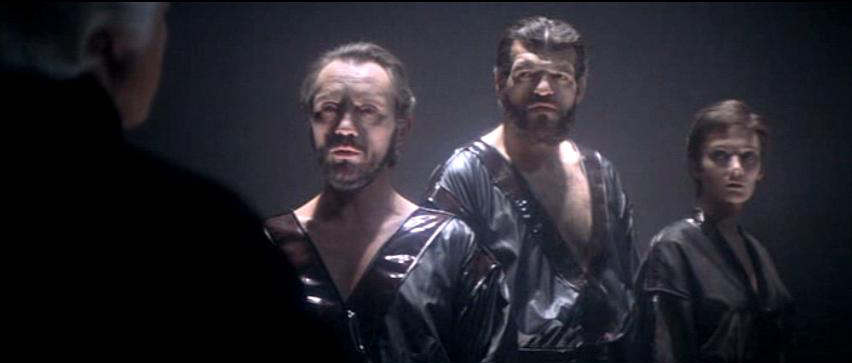
Never mind those 1970's track suits. These were real villains
with little regard for the laws of Earth or Krypton.
The film was a monster success, still widely considered to be one of the best super hero movies ever made, and that's in a world that currently includes Spider-Man II, X-Men II, The Avengers, and Batman: The Dark Knight. Why does it work so well? Special effects have gotten exponentially better since then. There's not even a super villain (meaning, a super-powered villain) in the movie. What makes it work?

Chris Reeve's Superman is the Superman for Generation X because it was a complete overhaul of the character at the time. When it came out in the late 1970s, it was a re-interpretation of everything that had gone on before. It was almost iconoclastic. Compare the movie to the comics of the late 1970s--wait, on second thought, don't bother. It's a night and day difference. What the movie did was ground all of the lunacy of the comic books from the 1950s and 1960s and take the good parts that worked, and replace the rest. There is no Toyman, no Mxyzptlk, not even Brainiac...there is only Lex Luthor, and he bears literally no resemblance to the mad scientist who wears a mechanical suit of purple and green armor and blames Superboy for the loss of his hair. Yeah. That's all straight out of the comics.

Chris Reeve's turn as Clark Kent was the best-ever take
on Superman's Secret Identity. He was the total package
from physically altering his posture to the octave change
in his voice (a trick from the old radio show). Watching
him almost morph from Clark to Supes and back again
is one of the best scenes in the movie.
In Superman: the Movie, Luthor is pro-active, removing the threat of Superman before Superman even knows he's got an arch enemy. That Luthor fails isn't because the plan didn't work. He didn't calculate on human emotion. Miss Tessmacher is the Goddess in the Machine that allows Superman to interfere directly with human events (the timestream). He makes and keeps a promise, and then when that cost is paid, he uses his powers to fly backwards in time and be literally two places at once. Why? All for love. So he can save Lois Lane.

See, the stuff that they kept, and moved forward into other versions of Superman, such as Lois & Clark and even Smallville, is that romance with Lois Lane. There is an emotional core to Superman, and that's part of the struggle he has, balancing the needs of the people who depend on him with his own happiness. We'll come back to this later.

Where was I? Oh, yeah, 1978. And of course, one can't watch Superman without discussing Superman II--flawed in execution, but we have all forgiven those lapses because of the three rogue Kryptonians and the ensuing fight between them and Superman. Awesome in every respect, and it's in that fight that we are shown something fundamental about the character. To quote General Zod, "He cares. He cares about these humans." Of course, we knew it already, but for the more obtuse members of the audience (hey, it was the 1980s), this is a core concept for Superman.

My first betrayal as an adolescent geek.
This movie was supposed to be better
than the first two, and yet, it wasn't.
At all. In any way, shape, or form. I
personally think one of the many
reasons was the attempt to try and
marry more of the comic book stuff
into the movie. That's where the
silly tone come from, largely.

Granted, being a member of Generation X also means we have to at least acknowledge Superman III. No one asked for this, and I'm still not sure why we got it. Or the fourth movie, which was even more terrible. But it doesn't matter, because in 1988, something interesting happened: Superman's 50th Birthday.  And our birthday present from DC comics was John Byrne's Man of Steel.

This was the first public acknowledgement of a character revamp for Superman. Byrne was, at the time, a respected and popular comic book writer and artist, and this was an extremely high profile job. He was tasked with cleaning out the Superman closet. Get rid of super-ventriloquism and freeze breath and all of the other goof-ass things that made Superman such a buffoon over the years, and give us a Superman for the modern era.

Well, the first place Byrne went to was the Superman movie. Yeah. He pulled a lot from the film in terms of tone, in terms of scale, and in terms of sensibilities. This was before Tim Burton's creative interpretation of Batman, remember, and so to remake a super hero as iconic as Superman was a bold move, but it was one that worked. Goofy Luthor was no more. Now he was a wealthy industrialist with vast resources, pretty much the image of Luthor that everyone since then has grown up with. Byrne also scaled Superman's powers way down. Way down. He was still the most powerful guy around, but no more of this planet-juggling strength, or flying so fast that he could break the time barrier. That was crucial, because, otherwise, how do you write for a character that can do anything? That's where Kryptonite came from in the first place, after all. They needed it for the radio program because the writers couldn't envision a scenario that Superman couldn't punch, fly, or otherwise demolish his way out of. They had to give him something to weaken him.

Everything in this movie was a love note
to Chris Reeve's Superman. The only prob-
lem was this: we didn't need a love note.
We knew it was great, and this re-tread over
familiar ground wasn't necessary.
But you probably know all of this, right? After all, you're like me, or mostly so. We have a lot of shared experiences in common, especially if you're around my age, give or take a few years. So, we're going to skip ahead to 2006 and the spectacular failure that was Superman Returns.

This is a film that should have worked. The special effects got a much needed upgrade. We saw a bullet bounce off of Supeman's eyeball, for crying out loud. That was very cool.They went back to what had by then become sacred source material: the original Richard Donner directed Superman: The Movie and Superman II. They did something we've all been doing for decades: they pretended that the third and fourth Superman movies never happened. So why did it fail?

I think the answer lies in why Man of Steel is currently doing so well. That Superman was our Superman (meaning, my generation), and while we are certainly all movie-goers, we're just a fraction of the total audience. There were more people who considered those movies "old" and "classic" and less charitably, "dated" than there were us. And you know what? They were right. In the same way that I watched George Reeves playing Superman in the 1950s and feeling like I wasn't in on the joke, Brandon Routh's earnest Superman failed because it wasn't the Superman for Generation Y (or, if you prefer, the Millennials).

It has been argued that comics are a reflection of their time period, and they mirror the concerns and the ideals of each new generation that discovers them. I agree with that, for the most part, but I think there is an exception found in Superman. I think we tend to re-invent Superman, not as a reflection of the zeitgeist, but rather as a reaction to it. We remake Superman into what we need at the time. I can't think of any other super hero or fictional character from popular culture where this is so. It seems to be unique to Superman. But when you think about it, we can chart Superman by the decade and see that he's either a call or a response to each era.

There's a lot to say about Lois chasing
after Superman, trying to get him to
settle down, have kids, etc. Was it
a reaction to the soldiers coming
home from World War II? Or was
it aimed at the young girls who wanted
romance with a modern day Prince
Charming from another world...?

When Superman first appeared, he was a populist reaction to the people working outside of the system, taking unfair advantage, etc. It was the late 1930's and the Great Depression was still coloring and shaping politics and culture. Superman of 1940's  became an ideal, and not just of the "ubermensch" variety, either. Truth, Justice, and the American way were the order of the day, and Superman's marching orders were very clear: lead the troops.

By the 1950's (and well into the 1960's, too), Superman's biggest adversary was Lois Lane and the threat of both exposing his secret identity, and putting a wedding ring on his finger. Most of Superman's other adversaries took on an otherworldly aspect, which makes a certain kind of sense in the uncertain times of the 1950s. The threat of exposure for Clark Kent also has an eerie resonance when you consider the Communist witchhunts of the mid-1950's. Superman gets even nuttier in the 1960's--lots of changes, don't you know. Red kryponite was a perfect plot device for these writers who were scraping the barrel to make Kal-El entertaining month after month.

By the 1970's, the comics were going nowhere, but the Superman movie gave us a breath of fresh air. Right in the middle of disco, jaded politics, and a new, emerging kind of cynicism that certainly colored my generation's participation in politics, here's this fresh-faced guy who never lies, believes in the goodness of other people, and is incorruptible. It certainly gave me hope, and I was only 9 at the time.

And so on, and so on, for generation after generation, while bored editors decide to take a character "back to their roots," only Superman gets updated to reflect the times in which he is operating.

If that's my premise, then, it would stand to reason that Man of Steel is Generation Y's Superman--the Superman they need right now. Certainly box office numbers would bear that out. Apart from Rotten Tomatoes, and of course, Mark Waid's spot-on breakdown of the movie, I haven't kept up with the Internet chatter. I'm willing to bet that everyone over the age of 35 had problems with the film, and everyone under the age of 30 is sneering at us old men in our black socks, standing on our collective porch, waving our canes at the punks.

Tom Welling played young Clark Kent for
ten seasons on Smallville, and they also
ran a super team's worth of similarly hot
teen heroes we were supposed to recognize
like Cyborg and Aquaman. Big deal. But I
ask you: can that kid smolder, or can that
kid smolder? Heat vision, indeed...
I can't argue with any of it, really. It's not the movie for us. We had our movie, some 25 years ago. It still gives me goose bumps to watch it. The sweeping soundtrack, the first time Clark yanks open his shirt to reveal the iconic S on the chest, the wry asides that sort of snub their noses at the older generation, like when Clark's looking for a place to change and he stops next to a payphone, looks it up and down, and runs on. No one under the age of 40 gets that Superman changing in a phone booth was, like, an established thing for decades. That's my Superman movie, and I can still watch it, but let's be clear: it's pure nostalgia that fuels my feelings for the movie. I haven't felt a connection with Superman in years.

They've tried, God bless 'em, they really have. Lois & Clark: the Adventures of Superman was a joke, it really was. As much as I liked the cast, they just didn't work for me. Why even make a soap opera about the most powerful man on the planet if all he's going to do is untie Lois Lane every week? Same thing with Smallville. I know many of you liked the series, but more teen angst I just do not need. I suspect the audience for these shows were starved of a certain kind of super heroic entertainment that DC was (and largely still is) incapable of producing on a large scale. Only their animated series scratched any kind of itch, and that we completely due to Paul Dini and Bruce Timm, and I think we can all agree on that.

The Mego Superman Action Figure, one
of the greatest toy lines of all time. The
reason: scale! When everything was the
same scale, the mash-ups that occurred
were inevitable. I still loved using the
Enterprise Bridge Set to transform Mr.
Spock into a gorilla soldier from Planet
of the Apes. It was a simpler time...


We can also agree that while the Superman (and other) cartoons were great, they weren't being watched by all of the people who turned up to see Man of Steel this weekend. I think it's fair to say that the audience in the theater was largely made up of people who knew about Superman, but didn't know Superman the way we know Superman. They know the broad strokes, the popular culture commonalities that exist out there in a communal state, ready to be accessed any time a rock band needs a quick metaphor or a sketch comedy troupe needs a topical skit. When it comes to defining a character like Superman, you need a movie to reach the most people, and in Man of Steel, Generation Y got their man.

But what did they get, exactly? I'll defer to Mark Waid's commentary, for the most part. I think he covered the ground pretty well. Truthfully, I'm still struggling with whether or not I liked the movie enough to say I liked it. I think for most of my writerly friends, we called it as soon as we heard that Zach Snyder was helming the project--we all said that it would be pretty, but ultimately devoid of heart, and that assessment is accurate. Snyder's use of the CGI medium has certainly matured, and he's finally gotten rid of that slow-mo-fast-mo-slow-mo explosion shot that has dogged him since his first film. He has replaced that shot with a hand-held camcorder that is supposed to lend immediacy to the scenes, but only makes me want to pop a handful of dramamine.

One of the best comics of the 1970's by any
definition. Art by Neal Adams.

The movie was well-cast, except for Amy Adams, who is wasted in her role as Lois Lane. It's not her fault; it's just that the part isn't there. There's almost no characterization for her. The only reason we buy her as Lois Lane is because we are told to. Michael Shannon is tremendous as the very believable General Zod who is not evil, merely villainous. At least, initially. I liked everyone else in the movie, even the leading man, Henry Cavill, who certainly looks the part, even if he had very little to do as an actor.

For me, the biggest disappointment and I think a failing of the film is this: I didn't connect with Superman, or Clark Kent. Not at all. Not until the death of Jonathan Kent did I feel even a pang of sympathy for him. But that's all right, because Superman doesn't seem to care for us. See Mark Waid, above.

I'm not going to complain about the changes to the canon: Lois figures out Clark's secret identity pretty quickly, and with little fanfare. That's knocking out a major chunk of iconography, right there. I guess we're going to just trust that the reporter with the Pulitzer is going to sit on this one story, because of how it all sounds, when you add it up. The "strange visitor from another world..." part, that is. We are apparently at ground zero, in a world without super heroes (even though we get a couple of shots of LexCorp trucks). So, when Superman reveals himself (in costume, as opposed to moving from town to town, helping with disasters and bullies before moving on down the road, like David Banner from the Incredible Hulk TV show), it should be a big deal, right?

Alex Ross, the Neal Adams of the 1990's, gave Superman that
timeless quality that we all sorta took for granted.  All of his
lush paintings seemed to recapture and redefine those essential
elements of the iconic super heroes. But Ross' reworkings
were not re-imaginings so much as the ability to hone in on
the nostalgic elements that everyone keyed off of. Ross'
Superman, then, was more what we thought he SHOULD
have looked like all along.
I never got that sense of gravitas, of awe, of wonder, and of joy. It's absent from this film. And the thirty minutes of disaster porn that makes up the last two reels of the film only call to mind what happened on 9/11 and how I felt about it then. That's clearly the vibe Snyder was shooting for, and he scored.  In fact, I did get anxious when I saw all of the buildings coming down, literally, like rows of dominos, and do you know what my reaction was? "Superman will save them." But he didn't. He just didn't. I'm on record as being the guy who says its okay to rework comic book characters for the big screen provided you get the core of the character right. This isn't mechanical versus natural web shooters we're talking about, here. It's a fundamental re-write of the core value system of a seventy five year old character that is one of the most recognizable characters on the entire planet.

This promotional image should tell you everything
you need to know about the Lois & Clark TV show.
And yet, I didn't know how good I had it...
I think I've just made up my mind about the movie. This is bullshit. Kudos to DC; you may just have jump-started your slow march to a Justice League movie. But if this is how you start the journey, it's going to be more like the Bataan Death March.

In addition to the wanton destruction of Metropolis, the whole thing felt as if it were free of consequences. I kept expecting there to be a scene like in Superman II where he begs the rogue Kryptonians to leave the civilians alone. I never got that moment. It was not just weird, it was off-putting. I would never have guessed that the part of the character most in need of a revamp was his heart and his empathy.

That's not to say that I didn't enjoy the visuals. They are sumptuous, especially on Krypton. And the Superman-Zod fight is one of the best super hero battles I've ever seen on film, ever. When the movie works, it works as grand spectacle, even as Snyder is pulling images from seventy five years of memorable scenes. The oil tanker wall catch, for example, is lifted straight out of the Fleischer cartoon where Superman catches a falling building. But that's not a problem, as far as I'm concerned. Part of the fun of a movie like this is throwing those iconic moments into the film for more resonance. Man of Steel needed all the help it could get, I tell you what. As I watched it, waiting for my heart to start caring about what I was seeing, I reflected on this version of Superman. This cold, pale, conflicted, Superman, who is told to protect the secret of his super powers because basically, people are a cowardly, superstitious lot. Wow.

The days of the Super Friends are over.
These cartoons are now a cultural
artifact unto themselves, and not in a
good way. Especially the Wendy and
Marvin years.
I've heard some people are laying the film's dark tone at the feet of producer Christopher Nolan, who of course, gave us his recent Batman trilogy, to much critical acclaim. Maybe. Maybe not. Just as both characters are orphaned by tragedy, the point of Superman and Batman as a study in contrasts is that they take different paths. Batman embraces the dark. Superman, the light. But the light that this Superman embraces is a post-9/11 sunrise, where authority figures have to make difficult decisions and calculate the value of one life for many, and also have to ponder just how dirty do their hands have to get in order to accomplish their goals. How else do you explain Superman snapping Zod's neck at the end of the film?

There's no Phantom Zone reprieve, there's no re-wiring the molecule chamber to take their powers away...it's just a difficult choice that does clearly cause Superman great anguish, but doesn't prevent him from pulling the trigger. Granted, we've seen this before in--wait for it--the comic books. Remember those? John Byrne killed the Phantom Zone renegades in his stewardship of the Superman character. And it was a big, huge deal. It impacted Superman negatively, and spun out into a story line that took years to resolve. It fragmented Superman's core identity and brought about a split personality! THAT'S how big a deal it was. Because Superman doesn't kill, you see. Well, not until the end of the 1980's, that is. I'm sure there's come cultural relevance there, but I'm too exhausted to seek it out right now.  But after Superman snaps Zod's neck, and cries out, we go straight to a shot of him smirking at the General and telling him, "you're not the boss of me." So, yeah, extreme actions carry very little consequences whenever they are used to stop American deaths. I wonder, out loud, if there are any parallels to our current political climate that could be used as a metaphor here? But I digress. As thirty minutes of disaster porn cascaded over me, rendering me numb and cold, I could see that the film was leading up to this final confrontation, and I felt like I was watching Seven all over again. Snyder gives us the ending we're asking for, but it doesn't make anyone feel any better.

I bought this treasury edition with my own
money. And it was so very worth it.
Check that. It didn't make me (or Mark Waid) feel any better. Everyone else, from the looks of the box office and the comments I've seen, loved it. The critics remain unmoved in their lukewarm appraisal of the film, but the rest of the world is happy that Superman has been re-defined and updated into a "real hero." You and I know that this is only good for, what? Ten, fifteen years? And then we'll re-define Superman again, and that'll be the flavor of the month. I know now that it had to happen. I'm just not very happy with what it says about us as a people right now. Then again, there's this website, something that could only have come about in the Millennial Age; a post-modern, ironic deconstruction of established popular culture. Ah, well, we have to tear down the old idols before we can put up new ones, don't we?

If you'd rather hear me waxing positive about Superman, you can download and listen to the recent RevolutionSF Roundtable Podcasts wherein I talked all about what I liked about the character with my fellow round tablers. It's a lively show, especially when I start making fun of Doctor Who. Give it a listen, won't you? Part 1 is here and Part 2 is here.

UPDATE: 
David Goyer answers a lot of questions and concerns in this letter to Bleeding Cool. I appreciate him breaking radio silence, and he does seem to address and confirm a couple of points I made in the post above, but he seems to be trading "heroic" for "realistic" as adjectives and I don't think I buy that. Not quite. One of the best scenes in The Avengers was the scene where Cap saved the people in the bank. It's a standout scene in the big battle, and it's full of Kirby-esque dynamism that speaks directly to Cap's character in every way. You can't tell me that in thirty minutes of disaster porn, you couldn't tip in two minutes worth of scenes where young, inexperienced Clark Kent is saving lives--you know, like the one he couldn't save, his father's...? Did I miss a piece of motivation, there? One second of a man flying out of a window of a building that Superman destroyed--he looks down, and sees him falling, and their eyes lock--and then we cut to a one second shot of Jonathan Kent with his hand up, the tornado swallowing him, young Clark screaming--and then we're back in the present day, and Superman's mind is made up: never again! His eyes darken, his jaw sets, and he swoops down and plucks the man out of the sky and lands, only to immediately leap into the air again.

The man watches him go, crying, and laughing.

Don't tell me there wasn't room for that in the movie. I don't believe it. And if Goyer didn't think to include it, then that's his failing.