Showing posts with label about me. Show all posts

Wednesday, May 6, 2015

Joss Whedon, The Black Widow and Why You Shouldn't Care


SPOILERS AHOY! I will ruin the movie for you if you haven't seen it yet. You have been warned.


Sure, it's big and loud and crowded.
Did you see the other one? Why
even bring something like that up?
Just look at the poster.
I was too busy this weekend hosting the Avengers: Age of Ultron premiere at my movie theater to get online. It was more fun to hand out Thor’s hammer, Cap’s shield, and my vintage Hulk hands for people to pose and play with as we snapped pictures in supplicated offering to the Great God Social Media. Everyone at my theater had a grand old time, as the pictures attest to, and everyone loved seeing their children and friends on Facebook.
  
Now, I’ve got this sour ball of ire in the pit of my stomach. It started on Monday when I learned that Joss Whedon deactivated his Twitter account. Then I read the messages he was getting, and I understood why. If you don’t know what this is about, you’re very lucky, and I’m probably going to ruin your day. Here’s the list of some of the tweets Whedon got all weekend. Feel free to scroll quickly lest some of the bile spew onto you. 

Whedon has since come back on to say that the rumors he was forced offline by the barrage of hatred and threats was, and I quote, “horseshit.” Okay, Joss, whatever you say. But he did get a few licks in on his detractors before he resumed media silence. You can read those shots here, and he’s one hundred percent correct:  The crack about the snake eating its own tail is very prescient.

With the Interwebs in flames, I had to know myself what was going on. So I checked it out, and not only ran afoul of this poisonous group of outraged people, I ran into a second group of poisonous people: the Geek Critics who are now throwing super hero movies under the bus.  The whole thing has turned into “The Black Widow Controversy” and it has mired me in dark thoughts and anti-internet screeds for two days. 

I’m going to try and parse this out as succinctly as I can. Bear with me. There’s three levels of problems that need to be addressed, here. There’s the real world level of problems—the world you and me are walking around in right now. Then there’s the fictional world level of problems. This is stuff in the movie that may or may not make your collective tumors throb. Finally, we have the meta-fictional level—the commentary about the thing that we’re talking about. I’ll start with that level, first, as it’s the easiest one to understand.

We’re eleven movies into the Marvel Franchise, and fifteen years down the road from the invention of the modern super hero film. What’s now a part of the “tentpole” strategy to prop up the summer, these movies cost ridiculous amounts to make and generate ridiculous amounts of revenue. It’s not a fad, anymore. It’s a thing. It’s a given. And being that it’s a given, super heroes (and even comic books) have lost a lot of their outsider status in the wake of millions of new fans who never had to justify their reading habits from inside a high school gym locker. For some, that’s unacceptable. For others, it’s perfect time to employ the Contrarian Flip, the signature finishing move of the modern Urban Hipster. Now that everyone else likes it, I have to pick it apart to keep my Indy cred. 

This article by Slate Magazine writer Andrew O’Hehir is the encapsulation of that attitude. And while this piece is steeped in a puddle of self-loathing and smug, squinty asides designed to show just how Above-It-All he really is, he’s not alone. Most of the actual film critics are calling the movie problematic but still entertaining. Meanwhile the rest of the critics who eschew violence in movies, who don’t like anything with a car chase or an explosion, are dog piling on the film’s perceived problems.  

What else is new? Go pick any big movie from the last ten years—no, last twenty years. Go look at Titanic, if you must. Read the reviews. There’s always that guy, writing for the East Haverbrook Free Weekly, who has to point out historical inaccuracies and claim that if Cameron can’t bother to do his homework, then the movie deserves to fail. Nowadays, there’s literally hundreds of the East Haverbrook Free Weekly Movie Snob. And they all have very specific axes to grind when it comes to action/adventure movies, horror films, science fiction movies, super hero films, martial arts movies, or any other sub-genre of the Blockbuster Movie category. 

Who listens to them, anyway? It’s all static. It’s white noise. It’s Star Trek Enterprise Conduits—GNDN. Goes nowhere, does nothing. But, you know, by pointing out the absurdities of modern cinema excess, they’ve done their part, fighting the machine, and blah blah blah blah blah… Yeah, whatever.

So, what’s the fix? If you’re a critic, do us all a favor and just stop reviewing the thing you hate, especially when what you hate is popular and you aren’t part of the crowd. 

If you’re a consumer, just stop reading and watching reviews for the big blockbusters. Cut them all out. You know your mind already. You’re smart. You’ve seen the trailers, maybe read some news online. You already know if you’re going to see any given blockbuster movie, and whether or not you’ll be inclined to like it. You probably know within thirty seconds of seeing the trailer for the first time. Why listen to intentionally negative criticism? The world moves too fast to collect boat anchors.

Now, about these…well, I’m going to call them feminists, I suppose, but I’m not entirely convinced they are who they say they are. I think they THINK they may be feminists, but I’m very leery of hashtag activism because it’s way too easy to just jump in without thinking and get caught up in the swirl of the digital mob. It’s the online equivalent of a feeding frenzy, and I never want to be in the middle of one of those, either. Anyway. Let’s see if I can correctly summarize their concerns about Age of Ultron and Joss Whedon’s portrayal of Black Widow in the writing and directing of this movie.

I admit it, I had my doubts about
Scarlet Johansson. But she won me
over and is now one of my favorite
characters in the franchise.
1. Black Widow should never be kidnapped, because that’s misogynist, lazy writing.
2. Black Widow referring to herself as a monster and implying that she can’t have kids undercuts the entire basis of the character. By implying she’s not human because she can’t reproduce, that’s misogynist, lazy writing.
3. Black Widow is now the mother of the group, tending to Hawkeye’s wounds, calming the Hulk down, and picking up Cap’s shield, with a comment to match. By forcing her into the traditional role of caregiver, that’s lazy misogynist writing.
4. Black Widow would never be attracted to Bruce. Not with Hawkeye and Cap around! Come on, that came from left field. It’s not lazy, misogynist writing, but it’s just dumb because I wanted her to be with (fill in the blank), not that she needs that to define herself as a woman, or anything. Um, yeah. So.
5. Tony Stark’s rape joke. Whedon put a rape joke in the movie. By writing a rape joke into a movie, that’s misogynist, lazy writing. And you’re an asshole, Joss Whedon.

Okay, that’s about the size of it, I think. There were also a few comments about him being a racist, too, but mostly, it's about Black Widow. Those are the big complaints. Starting with number five, and working backward, let me confess something: I’ve seen the movie twice, and I missed the line they are talkingabout completely. It zipped right by me. Then, when I saw the term, I had to go look it up. I know a lot of weird, useless information, but that archaic term was new to me. And I’m a smart, well-educated person.

Let me assure you, if I had to go look up the term, then no one in my audience got the term or even understood its meaning. And so I say it across this great big stupid country of ours. In the Buzzfeed article above, there’s a snippet of the scene with a different line, and does it work better? Yeah, sure, but let me make this clear, here: that’s all in-character banter that is completely in context with the scene and the characters. No one, not the imaginary characters, nor the real actors and director, are advocating for the return of the monarchy. To suggest otherwise is naive at the very least, and willfully cognitively dissonant at the most. 

You didn’t like the way Black Widow and the Hulk nearly got together? I don’t have an answer to that, except maybe that’s what fanfic is for these days; redressing those supreme wrongs and claiming some kind of ownership of the characters for yourself. I thought it made good sense, since she’s obviously the one who did the Manchurian Candidate-style programming to calm the Hulk down to the point that it triggers the change. Of COURSE she’d be the one to administer it, just as she’d be the one to program Banner. That’s what she does as the super spy and master manipulator. Whedon has her explain her attraction to him and it works just fine—maybe a little bit rushed, but we are three to six months past the first Avengers movie at the start of the film. And really—WHO CARES? It doesn’t come to pass, anyway. Talk about a non-issue.

Black Widow isn’t the mother of the group. I think she’s decidedly a Jill of all Trades. Performing field triage on her best friend isn’t mothering. It’s good soldiering. Recovering Cap’s shield to help him regain the tactical advantage is good teamwork. And let’s be clear, here: she wasn’t “kidnapped.” She was captured after making the sacrifice play that allowed the Avengers to pry the Vision away from Ultron. As soon as she got to where she was going, she sent a message to Hawkeye telling the Avengers where she was. You know, master spycraft stuff. 

That crack about being a monster? Please. Her jacket is red, she says in the first movie. She was a Russian assassin for years. The fact that she was sterilized meant she didn’t have any distractions, like kids. If anything, it was an attempt to rob her of her basic empathy, her humanity. Killing without any remorse is what makes her a monster. 

At least, that’s how I see it. Then again, I have a blog, where I can type a complete thought using more than 140 characters. One of the huge problems I have with hashtag activism is that a great many of these subjects require a more complete thought in order to be discussed in a meaningful fashion. 

But some of these reductive, black and white statements about the movie ignore the other ten Marvel films that came before this one, and also especially the other movies in which Black Widow is featured. There’s no audience goodwill, no context regarding the character’s arc. No mention of the new Avengers at the end of the film, where Cap is suddenly the minority player on a team that includes two women and two black men. None of that is even alluded to. There’s only this weird, vicious pile-on because you didn’t like something—wait, scratch that—because you CHOSE to interpret something in the most narrowly-defined, reductive, and insulting way and that offense has spilled out across the Internet in the form of hate-speech and threats. Talk about seriously undercutting your own intentions. 

He's probably thinking about how he can most effectively
piss off a huge swath of his own fans in one fell swoop.
Oh, and I’ve said this before, though I never thought in a million, billion, trillion years I’d need to say it about the creator of Buffy the Vampire Slayer: putting a sexist remark in your work does not make you a sexist. Writing misogynistic dialogue in a scene doesn’t make you a misogynist. And showing violence done to women onscreen is not an endorsement for rape. In what high school or university are young people being taught that plot, characterization and dialogue all speak to authorial intent? It’s so weird how people miss the subtext inherent to a scene and simply invent their own, based on a literal reading of the dialogue. Who does that? Please, tell me how that is now a thing. Regardless, if you go through life expecting only to consume fiction and popular culture in all of its various forms that only conforms to your internal barometer for what you consider to be good and right and fair and just, let me tell you, you're in for decades of rage and disappointment. Sooner or later, you're going to have to learn how to deal with something you don't agree with.

We used to play this game in the 1980s—during the time when the ultra-right-wing of the church was actively campaigning against heavy metal music, Dungeons & Dragons, and Warner Brothers Cartoons. There was this dictum that Pat Robertson used to employ that boiled down to, “if it’s not For God, then it’s against God.” We got pretty good at taking anything commonplace and by the transitive or associative properties of language and numbers, proving that it was, in fact, satanic. Jello? The most popular color is red. Red is the color of the devil. It jiggles when you shake it. Much like how the body shakes while committing sin. But the real proof? How many letters are in Jello? Five. How many letters are in Satan? Five. That can’t possibly be a coincidence. Thus, if you like Jello, that’s Satanic. 

It’s a fun game. You should try it. Maybe some of you already have. Instead of Satan, look for misogyny. Or racism. Trust me, if you want to find it, you can. 

 Avengers: Age of Ultron does have its share of problems. Of everything on the list above, I think the Stark line of dialogue about being a firm but fair ruler is better than his line about Prima-Whatever and will likely be changed for the DVD. It’s problematic. And yeah, I agree, there should be room for a Black Widow movie of her own. It’s conspicuous by its absence. The romance certainly felt a little rushed. And yes, Jeremy Renner’s apology for calling Black Widow a slut was douchey and not at all helpful and it was obvious he wasn't sincere. All valid points of criticism and certainly worthy of rational discussion.

So what’s the fix? I think it’s imperative to redirect the conversation onto firmer ground. I also think it’s probably a good idea to assume people aren’t trying to put you in manacles with their movie project. I think everyone needs to take a deep breath and a step back. We’ve lost some things in this politicized, polemic world. We’ve lost context, and weirdly, also nuance. I don’t know if this comes from living and consuming pop culture both ironically and also sarcastically, but it’s an epidemic. 

Reducing everything to 140 characters isn’t better speech. It overlooks gobs of information. This need to slap a label, to pigeonhole, and worse, to damage with terms like racist and misogynist, is a trend borne from anonymous cowards and we need to seriously consider why we’re online—to what purpose—and if Twitter is taking up that much time in your life, I’d look at that as something to work on.

 
Catwoman and the minion approve of Natasha's Heel Toe Technique.
Finally, we get to the real world problem. This is a picture of my Black Widow action figure. I have it displayed in the big case in my theater. It’s a cool figure. Here, you can see she’s stomping the hell out of some Hydra goon. And it looks like Scarlett Johansson, too. This was a figure that came out last year, with very little fanfare, as part of another toy line. Thankfully, I got it from a retail store, instead of on the collector’s market, where female action figures fetch a higher price because there is always only one per case. That makes the figures harder to acquire, naturally.

The stores are full of Avengers toys, again, and some of them are pretty cool. In addition to the action figures and Legos, there’s the clutch of “role playing toys.” Cap’s shield, Hulk fists, Iron Man gloves and helmets, even Hawkeye’s bow and arrows. These kids today are pretty lucky. If there had been an Iron Man helmet I could wear as a kid, I would never have taken it off.  But you know what they don’t have on toy store shelves? 
 
You guessed it: No Black Widow wrist rockets, no Black Widow light-up Electro-Sticks, no Black Widow on motorcycle toys, no Black Widow anything. It sucks. It’s stupid and short-sighted. And do you know why (oh, you’re going to love this one). It’s all because of Disney.

Yep. They really don’t think that girls want to play with boy’s toys. I’ll let that statement sink in so those of you who are angry can shift focus. Disney did this with Gamora during the Guardians of the Galaxy merch-blitz last year. Now they are doing it with Age of Ultron. There’s a token figure of the Scarlet Witch, but of course, all of the collectors are pouncing on them and so you won’t find them if you have kids who are fans. Not without paying that collector’s premium. 

The reason why is the part that makes me legitimately angry, and if there was ever a need to rally the troops for a concerted campaign, it’s this: Disney bought Marvel because they wanted to sell product to boys. They consider Marvel a “boy’s line” and the “girl’s line” of characters is, of course, the Disney Princesses. That’s the danger. That’s the great Satan at work, right there. 

This article is a great call to action that succinctly explains what’s going on in retail right now.  I think it’s incredibly important that these characters, these stories, this fandom—which is an American art form and should be treated as such—deserve to be all access. We need to be okay if boys like Wonder Woman. We need to be okay with girls liking The Hulk. They are characters. Stories. Fantasy. American Myth. And now those myths, those ‘intellectual properties,’ are in the hands of lawyers who consider them to be dollar-generating concepts that they control. Where’s your Internet outrage now, Twitter? There’s the fight. There’s the opponent. Let’s go get them! Let’s start talking action and activism! Let’s change the landscape! 

Of course, in order to do that, you’d have to stop texting “Fuck You, Joss Whedon” and complaining about the Hulk/Black Widow relationship. That may be asking too much of some people. I heard the term Manufactured Outrage and while I don’t think it’s always the case, BOY do I think that about this particular instance. Someone put a little blood in the water, and everyone’s nictitating membranes slid right down over the eyes so that they could feed without getting blood in their eyes.  

Maybe Whedon made some choices you don’t agree with. Okay, fine. But remember this: that film was made by committee, and you have no idea what forces were in play during all of it. The fact that Whedon is taking a break because he’s physically exhausted should say something about the process of dealing with Disney. Anyone who chooses to take a line of dialogue so seriously that they flip out like a ninja on social media needs better priorities in their life. 

But the threats? The Name-Calling? That's not acceptable. It wasn't acceptable during GamerGate, and it's sure not acceptable now.  You're doing it wrong.

There, now that everything is all sorted, here’s another article on another website about movie criticism. It’s a cogent, well-articulated call to action. For those of you wanting things to change on the meta level, this is a very good place to start.

Tuesday, August 12, 2014

O Captain, My Captain: Robin Williams (1951-2014)

I watched this show religiously for Mork's antics.
Bonus: I had a thing for Pam Dawber, too.
If you were in grade school in the late seventies/early eighties and your name was Mark, and if you happened to be the class clown, then you were "Mork" until middle school.

Robin Williams was my first comedian. "Mine" in the sense that I took ownership of him. Sure, I listened to my mother's comedy albums (Kids: Google "album"): Lily Tomlin, Flip Wilson, and especially Bill Cosby. Great stuff, all, and very funny. But Robin Williams was the comedian that I discovered myself, first on Happy Days and then in Mork & Mindy. My god, he was funny. I don't know if the act holds up, but at the time, there was nothing like him to be found anywhere else.

Because of Williams' performance as Mork (and mostly any other comedy role he ever took) I learned about improvisation, the art of the ad-lib, and best of all, he re-introduced the world to Jonathan Winters.

I was fascinated by him. That stream of consciousness babble of ideas, each one spilling out on top of one another... Of course, later, I found out that was the cocaine talking, but even when he quit doing blow, he was whip smart, and his observations were sharp and funny.

Over the years, his vast movie career has been a series of ups and downs. Lord knows, I haven't liked everything he ever did (Kids: Google "Hook"), but it's only because when he was on, he was brilliant. It made the lame projects stand out in sharp relief.

Some of the movie is very good. Loved the boxing scene.
I kind of want to talk about Popeye right now. I know not everyone liked it, and it lacks, well, a lot in terms of what people were expecting to see. But as far as recreating Thimble Theater (E.C. Segar's strip in which Popeye appeared) goes, it was pretty good. For recreating the Famous Studios cartoons where Bluto is always grabbing Olive and saying, "Hey Doll, Howzabout a Kiss?" the movie was a flop. However, when I'm in the right mood, I love the movie. The art direction is brilliant, the characterizations are fantastic, and to my chagrin, I even like the songs. Mind you, if you ever ask me my favorite comic book movies, it will never be on the list. When I watch it, it's because I'm feeling nostalgic for the early 1980s.

So much of how I approached being funny was tied up in trying to figure out what made Robin Williams tick. Dropping instantly in and out of character and being able to sell a bit onstage are about as far as I got. No one put stuff together like him. His timing, along with his ability to economically cut out everything that didn't look like the joke, was his singular gift.

I was there for all of it. His HBO specials, his early critical acclaim, his later critical acclaim, his transition to elder statesman, all of it. I hated it when I didn't like a movie he was in, or the film was bad, or whatever. I wanted to like everything he did. And looking over his incredible resume, I liked way more than I didn't like, and you can't ever say that a .500 batting average is a bad thing.

Mime Jerry, from the Cult Classic Shakes the Clown.
These smaller, art house movies he did with Bobcat
Goldthwait and others are among my favorite things he
ever did. You must watch World's Greatest Dad.
In the back of our minds, I think we all knew there was something wrong; he was laughing to keep from crying. We could certainly see it in his sobering film roles, or the occasional interview where he's not climbing over the furniture. That razor sharp observational humor cut both ways, and sometimes, you'd see it nick a wrist. I've seen a lot of references to the old joke with the punchline, "But Doctor, I AM Pagliacci," and I think that's apt, and sadly, very prescient for a lot of performers, writers, and actors. Some people need the energy to thrive, and some need the energy to just keep their heads up.

I don't know about all of that, really; it's pure conjecture, and I don't know that we'll ever really know the whole story. I don't know if I want to. In the last few years, I had noticed when he had a heart attack, got divorced, and then very recently, went back to rehab. Those things were happening a little too close together, and I was actually saddened and concerned. Then this. It feels like someone just slammed the door on my childhood. I never met the man, but he's a part of my humorous DNA.

I hate that he felt he was out of options. I don't know if anyone knew how much pain he was in. All the laughter--the belly-aching, side-splitting, howling and crying laughter, and all of the cathartic tears and genuine anger, rage, and sadness, he brought out in everyone over the years, and it still wasn't enough.

Dammit.

Go listen to Marc Maron's very poignant eulogy and rebroadcast of his interview with Robin Williams on his WTF podcast. He really nailed down a lot of things for me, and if you're struggling to cope with this, his words may help you, too. 

Sunday, July 20, 2014

My Thoughts About James Garner

One of the best-written TV westerns of all time.
He was one of my all-time favorite actors.

The L.A. Times wrote a cogent and, I think, really well-nuanced obituary of Garner. Dennis McLellan is clearly a fan, as he made the point several times that Garner was an amazing actor. He never looked like he was acting, and everything that came out of his mouth was natural and pitch-perfect. As I've gotten older, I have come to really appreciate the guys who don't look like they are doing anything, but they end up saying everything.

My first memories of Garner are tied directly to my grandfather, who used to watch Maverick and The Rockford Files religiously. He liked other TV westerns, like Gunsmoke, but he loved Maverick. Specifically, he loved James Garner. And who could blame him? The wise-cracking, laconic gambler who gets in over his head with the ladies and outfoxes the bad guys at every turn. What's not to like? As a child, I never understood it when Bart Maverick was in the show instead of Bret. I didn't realize they were supposed to be brothers, or why that was interesting. All I know is that when Bart was on, Pappy drank more read the paper.

Thankfully, Jim Rockford didn't have a brother. Mike Post's theme song is a permanent groove in my mental jukebox. I can't ever see a picture of Garner from the seventies without that music cuing up, an autonomic response borne out of years of conditioning. I've been rewatching The Rockford Files on Netflix these past few months--one or two a week, more or less as they were intended to be watched, and it's a joy and a treat to see Garner in action in his heyday.

My grandfather died when I was fifteen. I went to his funeral and didn't quite know how to say goodbye to the man; it was my first experience with loss on that level. I have spent years of my life picking through the memories I have of "Pappy" as I called him. I collected stories about him, from anyone who'd tell them. I don't know my grandfather personally--that is to say, he was different when he was around me--but I am pretty certain that he envisioned himself to be the kind of character that James Garner liked to play on TV. More mischievous and less anti-hero, maybe, but no less charming. He played cards, drank like a fish, had a positively caustic wit, and even pulled the occasional "heist." When he needed lumber for some project that he and his friends had cooked up, my grandfather would put on a coat and tie, grab a clipboard, and a yellow hard hat, and drive out to a construction site in a battered blue pick up truck and order some lackey to load two by fours, plywood, and anything else they might need into said truck bed. My grandfather owned a shoe store, but apparently, he was a pretty convincing actor, as well.

From the inimitable opening montage to The Rockford Files.
The show does an excellent job of deconstructing the P.I.
and then building him right back up again.
I don't know if my grandfather would have gotten along with James Garner had they met, but it doesn't matter, really. Pappy had his romantic notions, and I had mine. Because my grandfather is little more than a sketch to me, I've taken on some of his likes and dislikes over the years in an effort to bring myself closer (in head space, if not heart space) to the man. Just as my grandfather is in my style book of What Constitutes Manhood, so too is James Garner. The funny tough-guy or in some cases the tough funny guy, is a pose I could never pull off. 

But Garner is right there in my Frankenstein Monster's Version of Masculinity, alongside Steve McQueen, John Wayne, Clint Eastwood, Captain Kirk, Captain America, Errol Flynn, Frank Sinatra, Dean Martin, and Lee Marvin. Watching him over the years in movies like Support Your Local Sheriff and The Great Escape (one of my all-time favorite movies, a movie I have to compulsively watch if I stumble across it on television) only reinforced that idea of the fast-talking trickster in that mix of blistering testosterone. The eternal charming rogue. His scenes in The Great Escape with the hapless guard, Werner the Ferret are among the best scenes in the movie. The way he could put the pressure on someone, and still be so likeable, is a trait that people have been writing into his characters for decades.

I always felt a little guilty that I didn't watch 8 Simple Rules for Dating my Teenage Daughter. I was happy that Garner was still getting work, but I just didn't want to watch him as the grumpy grandpa. I much preferred (and still do) the "I do my own stunts" James Garner, or the "I race cars on the weekends" James Garner. The guy I grew up with. Even Space Cowboys or The Notebook James Garner was preferable to that.

I never got to grow up with my grandfather. I never got to drink a beer with him, and listen to him tell me about being a tail gunner in World War II. So I take what I can get. I watch James Garner and I go right back in time to that house, with that huge-ass console television, and the smell of roast beef and scotch, and the sounds of laughter in the kitchen of my mother and grandmother talking about something else. Not this. Me and Pappy and Dad are watching The Rockford Files. They're laughing about the answering machine message. It goes over my head. But one day, I will get the joke.

Rest in Peace, James Garner. Say hi to my dad, and my grandfather, if you see them.

Sunday, November 17, 2013

So, this happened after a couple of beers today...

Hey, Look, I made a video!

Okay, you merry band of misfits. You want me to talk more? Or type more? Or split the difference and do both?

Speak up, guys. I will do as thy will.

Thursday, October 24, 2013

On Birthdays and Thinking About What "Getting Older" Really Means

"Go away! Stop looking at me! MOOOOOOOM!"
I started this week in a foul mood. I'm not going to sugar coat it; it was my fault, entirely. It seems that I, for the first time in my life, forgot how old I was. Naturally, I was rounding down, instead of up, and even though my integer was only off by one year, it shook me up.

This has been a bad year, kinda, sorta, in that I sidelined several personal goals to handle some business for other people. Some of it was creative, and a lot of it was economic. But I've not been driving my own bus for about nine months now and I just recently wrested control of my vehicle back, to belabor a metaphor.

I didn't want any hoo-hah for my birthday. I'm turning 44. No, really, that's the actual number. Forty-Four. 4-4. Symmetry be damned, I was just not feeling it. So I told everyone that it was going to be just another day.

Thankfully, my wife chose not to listen. And since I didn't tell anyone else, the well wishes came rushing in via email, text, tweet, and a veritable deluge of FaceBook posts. I had a great breakfast, a good lunch, got a massage (which I desperately needed, it turns out), and basically took a mental health day. The few cards I got in the mail were all awesome, most especially the hand-made card my sister sent me that must have taken her a week to build. I got to catch up on some NCIS, and napped a little. Turns out, I needed all of that.

Happy Birthday, O Bringer of Food and Treats!
Is that for me?
Now it's the end of the day, and I just found out that Cathy and I have been cast in a radio theater production of "It's a Wonderful Life!" for the Backdoor Theatre's Christmas show. We're super thrilled about it, because we have been dying to do some radio theater for several years now.

Oh, and it looks like I have found a home for my Sailor Tom Sharkey stories. More details on that when everything is locked down.

2014 is going to be an aggressive expansion for me. Lots of things coming out for you to read and enjoy. I'm looking forward to 44. My bad mood was just that: mine, and mine alone. I don't feel old. I certainly don't feel any older. I'm not about to start attempting to "be" old, because of this weird idea that I'm just supposed to. That's not who I am. Never has been, so why start now? Pfft!

Thanks to all of you dear friends, family, fellow writers and artists, and chums from all over the world, for the great birthday wishes. I'm grateful for whatever brought us together, and I love you guys in whatever amount of affection isn't considered creepy and strange.

Sunday, June 16, 2013

Superman, Man of Steel, and my Thoughts on Both

Author's Note: Spoilers Galore. I'm going to get to Man of Steel, eventually, and when I do, it's full access. You've been warned.

The first Superman comic I ever owned.
A great cover, but a lousy comic inside.
Nothing against Curt Swan, but at that
age, I was not a fan. Now I appreciate
that artwork, mostly because I'm sup-
posed to, but it still doesn't move me.
Either by design or by grand accident,
Superman never really had a gallery of
iconic artists working on him the way,
say, that Batman or Spider-Man did.


I've been aware of Superman, near as I can figure, since the age of five. Thirty-seven years. And as a member of Generation X, I had the unique advantage of seeing a wider span of Superman incarnations over the years, thanks to being around during the age of television before Cable and the Internet. As a result, my thoughts on Superman are a little jumbled. I'm going to sort them out before I talk about  Man of Steel, because I think it's worth contemplating and trying to figure out where this new movie fits in the character's long and complicated history.

I am not sure if my first exposure to Superman was a comic book or a cartoon, but I remember which was which very clearly. Before cable gave us 200 channels with nothing on them, local stations bought syndicated packages of programming--reruns of old television shows, along with cartoons, two-reel comedies, and so forth. It's the reason why so many people my age know who the Little Rascals are, and why we prefer Bugs Bunny over Mickey Mouse. And, for many of us, why the greatest cartoons of all time are still the Max Fleischer Superman cartoons.

These cartoons were shown in between liberal doses of The Three Stooges, Casper the Friendly Ghost, and all of the other animated shorts that had been relegated to the status of "kid's cartoons." Of course, when I was a lad, there was a going concern on Saturday morning called The Super Friends, which morphed into the cooler, more interesting Challenge of the Super Friends, as I got older. When the Super Friends gave way to Super Powers, starring Darkseid, I was too old to care, but by then, the damage had been done.

I had comics, of course, but Superman wasn't my first comic book. In fact, it came later, but I remember clearly what my first Superman-only comic book was. It sure was different from the 1940s cartoons, and the vaguely-good-for-you Saturday morning fare. It was kinda static and boring, to be honest, and I found the Neal Adams cover art more compelling than the stories within (and really, can't we say that about a lot of Neal Adams' seventies comic book work?)

Maybe it was because this was someone else's Superman. I was old enough to read in the nascent fan and popular scholarship (which amounted to little more than introductions in trade and hardcover collections of comics) about the character's history. I had read popular myth about Seigel and Shuster, and Action Comics #1, and all of it. A weird, sick part of me has always wanted to see the Broadway musical, It's a Bird, It's a Plane, it's Superman! Just to see for myself, you know? It's the comic book equivalent of seeking out the Star Wars Holiday Special. You know you can't unsee it, but you have to scratch that itch.

George Reeves and Noel Neill from the 1950's TV
show. Cleverly produced, the powers-that-be still
had no choice but to fall back on character by-play
because there were only so many times we could
watch a hoodlum throw a rubber gun at Superman's
chest when he ran out of bullets.
There was another Superman in syndication, as well, and that was the 1950s television show starring George Reeves. These were shown, by the way, right alongside the 1966 Batman TV show reruns, the 1966 Green Hornet TV show reruns, and (at the time) Wonder Woman in prime time starring Lynda Carter. I'm seven years old. This stuff is going in with no filter, you understand? No judgements. It's all Super Heroes, with all that implies. There was no gradient for quality. It all looked basically the same: cheap and cheesy. We knew, for example, that the special effects were going to be crappy, because, well, how else are you going to have Batman walk up a wall? Or Superman fly?

Technical achievements aside, it was a great time to be a kid in the 1970s. This stuff was everywhere, from Slurpee cups to Burger King glasses and all points in between. My Mego Superman could rescue Captain Kirk from the Gorn, and together they could fight off the gorillas from Planet of the Apes. And it was all good. But I was borrowing all of it. There wasn't any of it that I took ownership of, as a fan. Not really.


Not until Superman: the Movie came to the theaters in 1978. "You will believe a man can fly," said the teaser campaign, and you know what? I did. The flying rig they used for the movie is still a thing of beauty. In a couple of scenes, Christopher Reeve takes off from the ground and is hoisted up into the air some twenty or thirty feet in what looks like someone literally defying gravity. No computers. Just really thin wires and smart camera work.

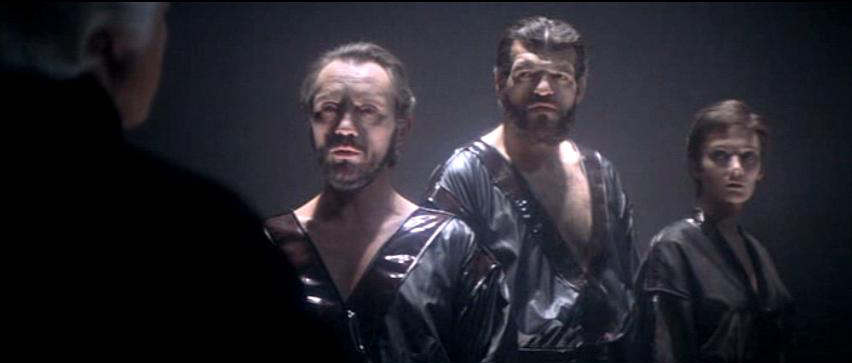
Never mind those 1970's track suits. These were real villains
with little regard for the laws of Earth or Krypton.
The film was a monster success, still widely considered to be one of the best super hero movies ever made, and that's in a world that currently includes Spider-Man II, X-Men II, The Avengers, and Batman: The Dark Knight. Why does it work so well? Special effects have gotten exponentially better since then. There's not even a super villain (meaning, a super-powered villain) in the movie. What makes it work?

Chris Reeve's Superman is the Superman for Generation X because it was a complete overhaul of the character at the time. When it came out in the late 1970s, it was a re-interpretation of everything that had gone on before. It was almost iconoclastic. Compare the movie to the comics of the late 1970s--wait, on second thought, don't bother. It's a night and day difference. What the movie did was ground all of the lunacy of the comic books from the 1950s and 1960s and take the good parts that worked, and replace the rest. There is no Toyman, no Mxyzptlk, not even Brainiac...there is only Lex Luthor, and he bears literally no resemblance to the mad scientist who wears a mechanical suit of purple and green armor and blames Superboy for the loss of his hair. Yeah. That's all straight out of the comics.

Chris Reeve's turn as Clark Kent was the best-ever take
on Superman's Secret Identity. He was the total package
from physically altering his posture to the octave change
in his voice (a trick from the old radio show). Watching
him almost morph from Clark to Supes and back again
is one of the best scenes in the movie.
In Superman: the Movie, Luthor is pro-active, removing the threat of Superman before Superman even knows he's got an arch enemy. That Luthor fails isn't because the plan didn't work. He didn't calculate on human emotion. Miss Tessmacher is the Goddess in the Machine that allows Superman to interfere directly with human events (the timestream). He makes and keeps a promise, and then when that cost is paid, he uses his powers to fly backwards in time and be literally two places at once. Why? All for love. So he can save Lois Lane.

See, the stuff that they kept, and moved forward into other versions of Superman, such as Lois & Clark and even Smallville, is that romance with Lois Lane. There is an emotional core to Superman, and that's part of the struggle he has, balancing the needs of the people who depend on him with his own happiness. We'll come back to this later.

Where was I? Oh, yeah, 1978. And of course, one can't watch Superman without discussing Superman II--flawed in execution, but we have all forgiven those lapses because of the three rogue Kryptonians and the ensuing fight between them and Superman. Awesome in every respect, and it's in that fight that we are shown something fundamental about the character. To quote General Zod, "He cares. He cares about these humans." Of course, we knew it already, but for the more obtuse members of the audience (hey, it was the 1980s), this is a core concept for Superman.

My first betrayal as an adolescent geek.
This movie was supposed to be better
than the first two, and yet, it wasn't.
At all. In any way, shape, or form. I
personally think one of the many
reasons was the attempt to try and
marry more of the comic book stuff
into the movie. That's where the
silly tone come from, largely.

Granted, being a member of Generation X also means we have to at least acknowledge Superman III. No one asked for this, and I'm still not sure why we got it. Or the fourth movie, which was even more terrible. But it doesn't matter, because in 1988, something interesting happened: Superman's 50th Birthday.  And our birthday present from DC comics was John Byrne's Man of Steel.

This was the first public acknowledgement of a character revamp for Superman. Byrne was, at the time, a respected and popular comic book writer and artist, and this was an extremely high profile job. He was tasked with cleaning out the Superman closet. Get rid of super-ventriloquism and freeze breath and all of the other goof-ass things that made Superman such a buffoon over the years, and give us a Superman for the modern era.

Well, the first place Byrne went to was the Superman movie. Yeah. He pulled a lot from the film in terms of tone, in terms of scale, and in terms of sensibilities. This was before Tim Burton's creative interpretation of Batman, remember, and so to remake a super hero as iconic as Superman was a bold move, but it was one that worked. Goofy Luthor was no more. Now he was a wealthy industrialist with vast resources, pretty much the image of Luthor that everyone since then has grown up with. Byrne also scaled Superman's powers way down. Way down. He was still the most powerful guy around, but no more of this planet-juggling strength, or flying so fast that he could break the time barrier. That was crucial, because, otherwise, how do you write for a character that can do anything? That's where Kryptonite came from in the first place, after all. They needed it for the radio program because the writers couldn't envision a scenario that Superman couldn't punch, fly, or otherwise demolish his way out of. They had to give him something to weaken him.

Everything in this movie was a love note
to Chris Reeve's Superman. The only prob-
lem was this: we didn't need a love note.
We knew it was great, and this re-tread over
familiar ground wasn't necessary.
But you probably know all of this, right? After all, you're like me, or mostly so. We have a lot of shared experiences in common, especially if you're around my age, give or take a few years. So, we're going to skip ahead to 2006 and the spectacular failure that was Superman Returns.

This is a film that should have worked. The special effects got a much needed upgrade. We saw a bullet bounce off of Supeman's eyeball, for crying out loud. That was very cool.They went back to what had by then become sacred source material: the original Richard Donner directed Superman: The Movie and Superman II. They did something we've all been doing for decades: they pretended that the third and fourth Superman movies never happened. So why did it fail?

I think the answer lies in why Man of Steel is currently doing so well. That Superman was our Superman (meaning, my generation), and while we are certainly all movie-goers, we're just a fraction of the total audience. There were more people who considered those movies "old" and "classic" and less charitably, "dated" than there were us. And you know what? They were right. In the same way that I watched George Reeves playing Superman in the 1950s and feeling like I wasn't in on the joke, Brandon Routh's earnest Superman failed because it wasn't the Superman for Generation Y (or, if you prefer, the Millennials).

It has been argued that comics are a reflection of their time period, and they mirror the concerns and the ideals of each new generation that discovers them. I agree with that, for the most part, but I think there is an exception found in Superman. I think we tend to re-invent Superman, not as a reflection of the zeitgeist, but rather as a reaction to it. We remake Superman into what we need at the time. I can't think of any other super hero or fictional character from popular culture where this is so. It seems to be unique to Superman. But when you think about it, we can chart Superman by the decade and see that he's either a call or a response to each era.

There's a lot to say about Lois chasing
after Superman, trying to get him to
settle down, have kids, etc. Was it
a reaction to the soldiers coming
home from World War II? Or was
it aimed at the young girls who wanted
romance with a modern day Prince
Charming from another world...?

When Superman first appeared, he was a populist reaction to the people working outside of the system, taking unfair advantage, etc. It was the late 1930's and the Great Depression was still coloring and shaping politics and culture. Superman of 1940's  became an ideal, and not just of the "ubermensch" variety, either. Truth, Justice, and the American way were the order of the day, and Superman's marching orders were very clear: lead the troops.

By the 1950's (and well into the 1960's, too), Superman's biggest adversary was Lois Lane and the threat of both exposing his secret identity, and putting a wedding ring on his finger. Most of Superman's other adversaries took on an otherworldly aspect, which makes a certain kind of sense in the uncertain times of the 1950s. The threat of exposure for Clark Kent also has an eerie resonance when you consider the Communist witchhunts of the mid-1950's. Superman gets even nuttier in the 1960's--lots of changes, don't you know. Red kryponite was a perfect plot device for these writers who were scraping the barrel to make Kal-El entertaining month after month.

By the 1970's, the comics were going nowhere, but the Superman movie gave us a breath of fresh air. Right in the middle of disco, jaded politics, and a new, emerging kind of cynicism that certainly colored my generation's participation in politics, here's this fresh-faced guy who never lies, believes in the goodness of other people, and is incorruptible. It certainly gave me hope, and I was only 9 at the time.

And so on, and so on, for generation after generation, while bored editors decide to take a character "back to their roots," only Superman gets updated to reflect the times in which he is operating.

If that's my premise, then, it would stand to reason that Man of Steel is Generation Y's Superman--the Superman they need right now. Certainly box office numbers would bear that out. Apart from Rotten Tomatoes, and of course, Mark Waid's spot-on breakdown of the movie, I haven't kept up with the Internet chatter. I'm willing to bet that everyone over the age of 35 had problems with the film, and everyone under the age of 30 is sneering at us old men in our black socks, standing on our collective porch, waving our canes at the punks.

Tom Welling played young Clark Kent for
ten seasons on Smallville, and they also
ran a super team's worth of similarly hot
teen heroes we were supposed to recognize
like Cyborg and Aquaman. Big deal. But I
ask you: can that kid smolder, or can that
kid smolder? Heat vision, indeed...
I can't argue with any of it, really. It's not the movie for us. We had our movie, some 25 years ago. It still gives me goose bumps to watch it. The sweeping soundtrack, the first time Clark yanks open his shirt to reveal the iconic S on the chest, the wry asides that sort of snub their noses at the older generation, like when Clark's looking for a place to change and he stops next to a payphone, looks it up and down, and runs on. No one under the age of 40 gets that Superman changing in a phone booth was, like, an established thing for decades. That's my Superman movie, and I can still watch it, but let's be clear: it's pure nostalgia that fuels my feelings for the movie. I haven't felt a connection with Superman in years.

They've tried, God bless 'em, they really have. Lois & Clark: the Adventures of Superman was a joke, it really was. As much as I liked the cast, they just didn't work for me. Why even make a soap opera about the most powerful man on the planet if all he's going to do is untie Lois Lane every week? Same thing with Smallville. I know many of you liked the series, but more teen angst I just do not need. I suspect the audience for these shows were starved of a certain kind of super heroic entertainment that DC was (and largely still is) incapable of producing on a large scale. Only their animated series scratched any kind of itch, and that we completely due to Paul Dini and Bruce Timm, and I think we can all agree on that.

The Mego Superman Action Figure, one
of the greatest toy lines of all time. The
reason: scale! When everything was the
same scale, the mash-ups that occurred
were inevitable. I still loved using the
Enterprise Bridge Set to transform Mr.
Spock into a gorilla soldier from Planet
of the Apes. It was a simpler time...


We can also agree that while the Superman (and other) cartoons were great, they weren't being watched by all of the people who turned up to see Man of Steel this weekend. I think it's fair to say that the audience in the theater was largely made up of people who knew about Superman, but didn't know Superman the way we know Superman. They know the broad strokes, the popular culture commonalities that exist out there in a communal state, ready to be accessed any time a rock band needs a quick metaphor or a sketch comedy troupe needs a topical skit. When it comes to defining a character like Superman, you need a movie to reach the most people, and in Man of Steel, Generation Y got their man.

But what did they get, exactly? I'll defer to Mark Waid's commentary, for the most part. I think he covered the ground pretty well. Truthfully, I'm still struggling with whether or not I liked the movie enough to say I liked it. I think for most of my writerly friends, we called it as soon as we heard that Zach Snyder was helming the project--we all said that it would be pretty, but ultimately devoid of heart, and that assessment is accurate. Snyder's use of the CGI medium has certainly matured, and he's finally gotten rid of that slow-mo-fast-mo-slow-mo explosion shot that has dogged him since his first film. He has replaced that shot with a hand-held camcorder that is supposed to lend immediacy to the scenes, but only makes me want to pop a handful of dramamine.

One of the best comics of the 1970's by any
definition. Art by Neal Adams.

The movie was well-cast, except for Amy Adams, who is wasted in her role as Lois Lane. It's not her fault; it's just that the part isn't there. There's almost no characterization for her. The only reason we buy her as Lois Lane is because we are told to. Michael Shannon is tremendous as the very believable General Zod who is not evil, merely villainous. At least, initially. I liked everyone else in the movie, even the leading man, Henry Cavill, who certainly looks the part, even if he had very little to do as an actor.

For me, the biggest disappointment and I think a failing of the film is this: I didn't connect with Superman, or Clark Kent. Not at all. Not until the death of Jonathan Kent did I feel even a pang of sympathy for him. But that's all right, because Superman doesn't seem to care for us. See Mark Waid, above.

I'm not going to complain about the changes to the canon: Lois figures out Clark's secret identity pretty quickly, and with little fanfare. That's knocking out a major chunk of iconography, right there. I guess we're going to just trust that the reporter with the Pulitzer is going to sit on this one story, because of how it all sounds, when you add it up. The "strange visitor from another world..." part, that is. We are apparently at ground zero, in a world without super heroes (even though we get a couple of shots of LexCorp trucks). So, when Superman reveals himself (in costume, as opposed to moving from town to town, helping with disasters and bullies before moving on down the road, like David Banner from the Incredible Hulk TV show), it should be a big deal, right?

Alex Ross, the Neal Adams of the 1990's, gave Superman that
timeless quality that we all sorta took for granted.  All of his
lush paintings seemed to recapture and redefine those essential
elements of the iconic super heroes. But Ross' reworkings
were not re-imaginings so much as the ability to hone in on
the nostalgic elements that everyone keyed off of. Ross'
Superman, then, was more what we thought he SHOULD
have looked like all along.
I never got that sense of gravitas, of awe, of wonder, and of joy. It's absent from this film. And the thirty minutes of disaster porn that makes up the last two reels of the film only call to mind what happened on 9/11 and how I felt about it then. That's clearly the vibe Snyder was shooting for, and he scored.  In fact, I did get anxious when I saw all of the buildings coming down, literally, like rows of dominos, and do you know what my reaction was? "Superman will save them." But he didn't. He just didn't. I'm on record as being the guy who says its okay to rework comic book characters for the big screen provided you get the core of the character right. This isn't mechanical versus natural web shooters we're talking about, here. It's a fundamental re-write of the core value system of a seventy five year old character that is one of the most recognizable characters on the entire planet.

This promotional image should tell you everything
you need to know about the Lois & Clark TV show.
And yet, I didn't know how good I had it...
I think I've just made up my mind about the movie. This is bullshit. Kudos to DC; you may just have jump-started your slow march to a Justice League movie. But if this is how you start the journey, it's going to be more like the Bataan Death March.

In addition to the wanton destruction of Metropolis, the whole thing felt as if it were free of consequences. I kept expecting there to be a scene like in Superman II where he begs the rogue Kryptonians to leave the civilians alone. I never got that moment. It was not just weird, it was off-putting. I would never have guessed that the part of the character most in need of a revamp was his heart and his empathy.

That's not to say that I didn't enjoy the visuals. They are sumptuous, especially on Krypton. And the Superman-Zod fight is one of the best super hero battles I've ever seen on film, ever. When the movie works, it works as grand spectacle, even as Snyder is pulling images from seventy five years of memorable scenes. The oil tanker wall catch, for example, is lifted straight out of the Fleischer cartoon where Superman catches a falling building. But that's not a problem, as far as I'm concerned. Part of the fun of a movie like this is throwing those iconic moments into the film for more resonance. Man of Steel needed all the help it could get, I tell you what. As I watched it, waiting for my heart to start caring about what I was seeing, I reflected on this version of Superman. This cold, pale, conflicted, Superman, who is told to protect the secret of his super powers because basically, people are a cowardly, superstitious lot. Wow.

The days of the Super Friends are over.
These cartoons are now a cultural
artifact unto themselves, and not in a
good way. Especially the Wendy and
Marvin years.
I've heard some people are laying the film's dark tone at the feet of producer Christopher Nolan, who of course, gave us his recent Batman trilogy, to much critical acclaim. Maybe. Maybe not. Just as both characters are orphaned by tragedy, the point of Superman and Batman as a study in contrasts is that they take different paths. Batman embraces the dark. Superman, the light. But the light that this Superman embraces is a post-9/11 sunrise, where authority figures have to make difficult decisions and calculate the value of one life for many, and also have to ponder just how dirty do their hands have to get in order to accomplish their goals. How else do you explain Superman snapping Zod's neck at the end of the film?

There's no Phantom Zone reprieve, there's no re-wiring the molecule chamber to take their powers away...it's just a difficult choice that does clearly cause Superman great anguish, but doesn't prevent him from pulling the trigger. Granted, we've seen this before in--wait for it--the comic books. Remember those? John Byrne killed the Phantom Zone renegades in his stewardship of the Superman character. And it was a big, huge deal. It impacted Superman negatively, and spun out into a story line that took years to resolve. It fragmented Superman's core identity and brought about a split personality! THAT'S how big a deal it was. Because Superman doesn't kill, you see. Well, not until the end of the 1980's, that is. I'm sure there's come cultural relevance there, but I'm too exhausted to seek it out right now.  But after Superman snaps Zod's neck, and cries out, we go straight to a shot of him smirking at the General and telling him, "you're not the boss of me." So, yeah, extreme actions carry very little consequences whenever they are used to stop American deaths. I wonder, out loud, if there are any parallels to our current political climate that could be used as a metaphor here? But I digress. As thirty minutes of disaster porn cascaded over me, rendering me numb and cold, I could see that the film was leading up to this final confrontation, and I felt like I was watching Seven all over again. Snyder gives us the ending we're asking for, but it doesn't make anyone feel any better.

I bought this treasury edition with my own
money. And it was so very worth it.
Check that. It didn't make me (or Mark Waid) feel any better. Everyone else, from the looks of the box office and the comments I've seen, loved it. The critics remain unmoved in their lukewarm appraisal of the film, but the rest of the world is happy that Superman has been re-defined and updated into a "real hero." You and I know that this is only good for, what? Ten, fifteen years? And then we'll re-define Superman again, and that'll be the flavor of the month. I know now that it had to happen. I'm just not very happy with what it says about us as a people right now. Then again, there's this website, something that could only have come about in the Millennial Age; a post-modern, ironic deconstruction of established popular culture. Ah, well, we have to tear down the old idols before we can put up new ones, don't we?

If you'd rather hear me waxing positive about Superman, you can download and listen to the recent RevolutionSF Roundtable Podcasts wherein I talked all about what I liked about the character with my fellow round tablers. It's a lively show, especially when I start making fun of Doctor Who. Give it a listen, won't you? Part 1 is here and Part 2 is here.

UPDATE: 
David Goyer answers a lot of questions and concerns in this letter to Bleeding Cool. I appreciate him breaking radio silence, and he does seem to address and confirm a couple of points I made in the post above, but he seems to be trading "heroic" for "realistic" as adjectives and I don't think I buy that. Not quite. One of the best scenes in The Avengers was the scene where Cap saved the people in the bank. It's a standout scene in the big battle, and it's full of Kirby-esque dynamism that speaks directly to Cap's character in every way. You can't tell me that in thirty minutes of disaster porn, you couldn't tip in two minutes worth of scenes where young, inexperienced Clark Kent is saving lives--you know, like the one he couldn't save, his father's...? Did I miss a piece of motivation, there? One second of a man flying out of a window of a building that Superman destroyed--he looks down, and sees him falling, and their eyes lock--and then we cut to a one second shot of Jonathan Kent with his hand up, the tornado swallowing him, young Clark screaming--and then we're back in the present day, and Superman's mind is made up: never again! His eyes darken, his jaw sets, and he swoops down and plucks the man out of the sky and lands, only to immediately leap into the air again.

The man watches him go, crying, and laughing.

Don't tell me there wasn't room for that in the movie. I don't believe it. And if Goyer didn't think to include it, then that's his failing.


Tuesday, May 7, 2013

Ray Harryhausen Is the Father of us All

Ray Harryhausen passed away today at the age of 92. He was, in so many ways, the architect of everything that is great about fantasy movies. If you are a fan of any big, well-realized spectacle of a fantasy film from The Lord of the Rings on down, you owe a debt of gratitude to Ray Harryhausen and his movies, because he set the template, wrote the style sheet on how these movies would be filmed and executed. There isn't a special effects man in the world who hasn't heard of Harryhausen and in some way benefited from watching his work. But Ray was more than just a special effects man--arguably a pioneer in the field of stop motion photography--but he was also an incredible, talented, visionary artist who spent decades breathing life into the inanimate. He was a wizard, a sorcerer, and we have all lost something singular and profound with his passing.

Ray's inspiration for creating movie magic was seeing King Kong as a boy. He told the story often, as famous people who are asked the same questions constantly are wont to do.  It's a good story, and a charming one, but it doesn't really get across the sheer chutzpah of what he did next. He started doing his own stop-motion animation in his garage and when he had enough to show someone, he sought out Willis O'Brien, the man who created the stop-motion effects for King Kong. O'Brien hired Harryhausen as an assistant on the movie, Mighty Joe Young, where he wound up doing much of the work.

O'Brien taught Ray all that he knew, but it was Ray who took that knowledge and elevated stop motion to an art form. His ability to sketch and sculpt served him well as he created better articulated puppets to work with. But whereas O'Brien helped Ray with some technical pointers, it was Ray who began to give his sophisticated action figures individual personalities, specific body language, and emotional arcs. The fantastic creatures didn't just move, anymore; they acted. They came alive. Each one different, no two alike. The cyclops in The Seventh Voyage of Sindbad reacts with confusion when he encounters the sailors. Gwangi the Allosaur plays with its prey. The baboon prince in Sindbad and the Eye of the Tiger is both a monkey and a man in equal measure. Every Ray Harryhausen fan has their favorite creation. But no one disputes Ray's crowning achievement, his technical triumph, in Jason and the Argonauts.

The film's climax has a skeleton horde rising out of the ground to destroy Jason and his crew. The scene is breathtaking in execution, and mind-boggling in its complexity. Ray was in charge of animating five or six skeletons at a time, and each of them had to move a certain way, in coordination with the actor's movements (filmed on location months before), and each of them constantly in motion. You have to think about what that entails:

Skeleton #1: attacking Jason. Head moving forward, left arm moving to block with shield, right arm recovering to swing, left foot back, right foot forward. Mouth closed.

Skeleton #2: attacking sailor. Head moving back. Right arm back. Left arm connecting with sailor's sword. Right foot up, moving to kick the sailor. Left foot planted.

Skeleton #3: Running forward to battle. Head forward, left leg up, right leg down, right arm back, left leg forward.

Skeleton #4: On ground. Head is down. Right arm on forehead, dizzy. Left arm on ground. Sword still in hand. Torso twisting to right. Left leg bent, knee up. Right leg straight out, swinging left.

Skeleton #5: attacking sailor: Head down. Right hand high, sword in hand. Left arm up, shield is connecting with sailor's sword. Body is moving back from the force of the blow. Right leg stepping backward, left leg planted.

Skeleton #6: Climbing onto platform.  Left leg is up, right leg bent and backward.Arms braced on platform at the elbows. Head forward, Mouth open in a scream. Starting to close.

Annnnd, click. That's one frame of film. Now, imagine having to do that for twenty-four frames of film. That's one second of the scene. But don't take my word for it. Watch the entire sequence for yourself.

Granted, you are spoiling the movie for yourself if you haven't seen it, but if you're reading this blog, I'm betting you have, and multiple times. I still smile and gasp when I watch this sequence. The little touches he put into the sequences, like the beheading, and the way the skeletons hover and wait for the sailor to fall before leaving him for another target. Again, there's that personality at work in everything Ray did. Some days were so intensive on this final scene that he was only able to capture three frames of film in one day. An eighth of a movie second. He did that for four and a half months, in a room, by himself, with no assistance from anyone else.

That's an artist at work, folks.

That scene alone is responsible for more people getting into stop-motion than anything else. Phil Tippett is an unapologetic fan of Ray's and Tippett did the stop motion effects on the Star Wars trilogy. If you thought the tauntauns were cool, Ray was their spiritual godfather. Later, when Jurassic Park was in development, Phil was brought in to work with the computer animators to help bridge the gap between stop-motion and computer animation.  Dave Allen and Jim Danforth were also Harryhausen disciples and they produced a lot of commercial work whenever Ray was locked in his room, working on the next movie. When Dinosaurs Ruled the Earth, Q, Caveman, Dragonslayer, and so many other (and some would say lesser) movies and TV shows (remember Land of the Lost?) were created by people who were inspired by Harryhausen. Here's a Volkswagon ad that Allen produced for TV starring a familiar face:


I got to meet Ray twice in my life. The first time was during one of the late, lamented Dallas Fantasy Fairs in the Late 1980s and early 1990s. Ray was a special guest and I was over the moon at getting to meet him. I'll never forget sitting in a jam-packed conference room with maybe a hundred other people waiting for his question and answer session. The moderator stood up and said, "Ray Harryhausen needs no introduction. Instead, here's a brief reminder of why we're all here today." The lights dimmed and then a montage of scenes from Ray's various films, all of them key scenes, all of them evoking gasps and cheers of recognition from the audience. Of course, the montage ended with the skeleton fight. Of course it did! And with that, the video ended, frozen on one of the scowling skeletons' faces. Everyone surged up and gave Ray a standing ovation to thunderous applause, and it was one of the first times I thought, "Okay, I'm not alone, here. Other people get this stuff, too!"

Years later, while working at BookPeople in Austin, I got my second chance. Ray had written a couple of books looking back on his career, with tons of artwork, sketches, behind the scenes photos and more. We were having a book signing for him at the Alamo Draft House, where Ray would introduce the movie that inspired him, King Kong, and then sign copies of his book. It was probably the best signing I ever worked on. King Kong and Ray Harryhausen. What could be better?

Even at his age, Ray was a trooper and gamely signed every book that showed up, along with some other oddities. I was again touched by the crowd; sure, there were some old timers there, but there were also a lot of young dads with their kids--and it was the kids who were there to see him. That's the power of those movies. That's the magic of Ray. And he was nice, gracious, charming, and personally thanked everyone who thanked him back. I'm so glad that Hollywood awarded him a lifetime achievement award while he was alive to appreciate it.

Now everything is computer-generated, and at its best, it's amazing, and I really believe that. But I think it's interesting to note that the most amazing stuff now is essentially modeling faces directly from human actors. There's a reason for this: modern special effects people--to an extent--don't have the skill set that Ray had. They don't take acting lessons to try and understand character motivation, or light and film their own sets, or do modeling in three dimensions. I'm not talking about the effects studios like ILM and Weta. They have, as a hive-mind, people who DO still do that, and do it well. I'm mostly talking about the guys who render for a living; sitting at a computer every day, working on whatever three or four second shot has hit their desk that morning, doesn't leave a lot of room for wondering what the dragon's motivation is. Modern filmmaking doesn't work that way. There's no room for artists, not when there's all of these shots to process. And so, we've lost a step.

In the passing of Ray Harryhausen, we've lost the man who took that first step.

Thank you, Ray, for the creativity, the artistry, for the hard work. Thanks for all of it.

Rest in peace.