Friday, July 5, 2013

Policing Our Own in the Geek Nation


Cosplay used to be the exclusive province of the actors
hired by the companies to portray their characters. That
time is long past.
 Okay, enough's enough.

I've got to talk about this, because apparently, it's just not going to fix itself. Between the Science Fiction community and the Comic Book Conventions there has arisen a weird and completely inappropriate response to the steady influx of new blood into the geek nation. One would think, in the year 2013, that the Geek Nation would be grateful for new blood, but apparently, the supposedly enlightened and forward-thinking super nerds of the world have a problem with letting "those kinds" of people into their fun house, never mind playing with their toys.

It's the Cosplayers. It's the Fake Fans. You know, the ones who don't really "get it." The ones who dress up instead of go deep into the underpinnings of a certain character. The ones who weren't persecuted and driven away from the village for their beliefs, you know, like I was, once, long ago. You know who I'm talking about...Girls.

That's right! Girls in our convention! And they are dressing up as Captain America, and having fun, and getting attention, and it's JUST NOT FAIR! Not when I worked SO HARD on my pun-filled filksong about Firefly. And nobody is listening now, because everyone is watching the costume parade, instead. 

Obviously, that's not me, but I imagine that a lot of the nerd-rage in the electronic gaming, Science Fiction and fantasy, and Comic book communities sounds a lot like this in their heads. You have to know, they don't know how it sounds to other people. But the backlash from all of this new attention has brought some old, deep, salt-encrusted wounds to the top again, and those wounds will have to be debrised before they can heal. As an aside, we maybe need to leave those people who are too wounded to join us on the next leg of the journey at the watering hole, where they can be picked off by natural predators.

It's hard to know exactly where to start with this topic. Tony Harris' rant about cosplayers and "fake fans" seems like a good point of entry to the discussion, because it highlights some serious anger that has nothing to do with what's being discussed. Then again, the more recent Science Fiction Writers of America's blow-up happened just a few weeks ago, so that could be more topical. If those stories seem too broad, let's talk about one case in particular that is emblematic of the whole problem: the Black Cat cosplayer's harassment incident.

I think this about says it all. Here's a woman who does regular cosplay, and at her local convention, to boot, and she's chosen to portray the Black Cat, aka Felicia Hardy. For those of you who haven't read comics in thirty years, she's basically Marvel's version of Catwoman, only she's romantically involved with Spider-Man instead of Batman. Here's a cover from one of her comics:
This was the most tame picture of the
Black Cat I could find online. 

Now, the cosplayer in the story above (and there's a picture of her in said costume) bears a striking resemblance to the Black Cat. As a cosplay goes, it's an A+ job, all the way.

Part of the reason why cosplayers do what they do is to get feedback for presenting an authentic recreation of the character. That's unmistakably an aspect of cosplay. So, if I were to walk up to her and say, "That's an amazing costume. You look just like the Black Cat!" then that would be an appropriate thing to say.

I could, also, if I were so inclined, choose to engage this person as if she were really The Black Cat. That's also an aspect of why people cosplay. It's not for everyone, obviously, but by and large, if they are wearing the costumes, they are engaging in recreating that character as an avatar for interaction. So again, if I was to walk up to her and say something like "You know, Felicia, I wish you'd stop pining away for Spider-Man and just move on. You deserve some happiness in your life, and chasing after that web-head isn't going to do it." That would be a weird thing to say, but it would also be an appropriate interaction. It would be less weird if I was in a costume as well, dressed as Batman, or Spider-Man, or whatever, and make some in-character joke, for the benefit of the audience that has by now gathered around, gawking, staring, and leering as is usually the case.

Or, as a last ditch effort, if you lack the social acumen to walk up to a woman in a public gathering and not make an ass of yourself, you can just snap a picture or two and walk on. I think that's kinda creepy, but hey, it's not my choice, either.

You know what's not an appropriate interaction? Anything in this article by Cracked Online, for starters. Or anything like what this one cosplayer had to deal with. At her local show. Where she knows people personally.

But that's cosplay. It doesn't spill over into the world of literary Science Fiction and Fantasy, right? Guess again, Chuckles. Cosplay has been around in the smaller sub-circles of fandom for decades. People were dressing in Star Trek costumes for years before it was fashionable to do anything else. When the stormtrooper costumes, the Boba Fett costumes, and the Jedi Knight costumes first showed up in force in the early to mid 1990s, do you know who was the most pissed about it? The Trek fans in costume! Yeah. How dare someone else do what we were doing first!

But those were teapot tempests, you know. When all of the fans broke open the seals on the gates of Fan Fiction with their Harry Potter stories...well, that was just ridiculous. Until, you know, it wasn't. When all of the teenage girls started showing up at conventions dressed as Sailor Moon, that was just a fad. You know, until it wasn't.

Then a couple of professional actors revealed that they play computer and online games, and well, that was interesting, in the way that you can go to the local fair and see a chicken that plays tic-tac-toe. And through it all, from the early 1990s right up to 2012, when the bantha pooda hit the fan, everyone else chose to ignore it. Fans could see the difference, but not articulate it. Conventions continued to employ out-of-work actresses as "booth weasels," dressing them as either sci-fi sexpots, or as Hooter's waitresses, in the assured hopes that the underwashed, oversexed Geekoid masses would flock to their tables and pick up piles of their Chinese-made tchotchkes branded with whatever shitty movie or television show they were trying to get us to watch. Costume contests exploded, and a bunch of really nice, professional-looking costumes, worn by people straight out of central casting, all looking better than the actors hired to stand outside the DC Comics booth, were everywhere. Suddenly, there's an influx of Steampunk in all aspects of the sub-culture, including a metric ton of books that were never considered to be "real" science fiction. Costumes were everywhere. Families of geeks were attending comic book conventions. It was mad, I tell you, mad!

Then the scandals started. The accusations rose to the top like curds in cream. And like a good curd, they were all loud and squeaky. I'd see one go across my computer screen and think, "Wow, that sucks. Well, at least it'll be dealt with swiftly." But then the scandals just kept coming. More and more, all in different flavors, but all basically revolving around a kind of weird battle of the sexes. And I think it boils down to just one thing: Girls.

I really think that the Secret Masters of Fandom that run these conventions every year, the older, more established professionals in all of these sub-industries, and the fans themselves need to stop and take a good, long look at where we are from where we started out. I can remember a time, not too long ago, when comic book convention were graced with only a few people in costume. There was usually one woman who dressed as a super hero--Dark Phoenix--and she was kinda crazy, so people gave her a wide berth. There were no "booth babes," and the ratio of men to women at these conventions was roughly 90/10.

That was twenty five years ago.

I knew my time had passed back in 2003. I was working as a manager at a bookstore in Austin, Texas, and we had a large number of geeks in our employ. Back in 2004, I thought that meant we had girls who read comics. I'd had a few discussions with them about it, but never anything deep. I just thought it was, you know, interesting, because when I was in high school, if I wanted one of my girlfriends to read a comic book, I would have had to tie them to a chair and pry their eyes open, Clockwork Orange-style. Of course, when I was in high school, saying the word "Batman" conjured up an image of Adam West, doing the Batusi, and nothing else. So, you know, that was my experience.

One evening at the bookstore, I was shelving books when I heard a conversation between two of the women working that night. These were young women, early twenties both. It was a passionate discussion, in the tone regularly heard throughout the store when discussion the merits of Hemingway or the plotlines of Jane Austen. They were arguing over which Green Lantern was the one, true Green Lantern. I am not kidding.

One girl was making the case for Kyle Rayner being "her" Green Lantern, because he is the one who best encompasses her generation. His problems, his personality...all part of what she liked best about him. The other girl was insistent that if it's not Hal Jordan, it's just not Green Lantern. Hal was the classic, she argued, and everything else was a dalliance or a sales gimmick.

I leaped out from around the corner and shouted at them both, "You can NOT have this conversation without including me!" They both scattered like grouse, laughing at the old man, but the truth of that story should be obvious. Fans, and especially the older (40+ years old) fans tend to think that they discovered, well, whatever they first discovered, and were the last people to dig on it.

THE FUTURE IS NOW

It's a new generation of fans now. These are fans who grew up in the age of Harry Potter, when it was okay to read for pleasure in school. These fans grew up with the Star Wars prequels, bless their hearts. They grew up with the Internet, where they met people and developed friendships for years that turned into meet-ups at national conventions that had little to do with interacting with the Guest of Honor and everything to do with interacting with one another. This generation grew up reading (and watching) Japanese pop culture and comics, rather than reruns of Star Trek. They never tried to piece together from their meager comic book collection how many multiple Earths DC had floating around. They google that shit, instead of chasing it down in back issues for years and years.

And most importantly, their fan activity is very different, though no less valid, than our own. They engage the material in ways that I never will. They write fan fiction to address subtext in a story. They make their own costumes by hand, to better identify with these characters. They flip the gender on a super hero in order to take ownership of that character when maybe the other choices available to them don't speak to them directly. There's probably a component of irony in there, too, for the guys who insist on dressing up as Wonder Woman, But that's neither here nor there.

These new fans don't codify, organize, memorize, and catalogue the details and minutiae of their favorite show or character. They are much more interested in the bigger picture.  For them, fandom is not a closed, private club that you have to know the secret knock and the password to get into. For them, it's wide-open, social, and interactive. This is the new fan dynamic. And it's here to stay.

Well, maybe not. Right now, I'm going to estimate that the male to female ratio at, say, ComicCon International is roughly 60/40. There are other shows with a national bent that may be closer to 55/45 or even 50/50. I'll just bet you that there are more female than male geeks at, say, A-Kon, which is all about Anime. But I think it's safe to say that with more women than ever involved in both the creative/professional side of these sub-cultures as well as the fandom side of these sub-cultures, it's time to move our mental picture of "what fandom is" forward into the 21st century. We're supposed to be the visionaries of modern culture. It's time we acted like it, dammit.

Now, if you're not playing along, I can assume there's one or more of three reasons why this is so.

1. You are bitter, old, and cranky. You remember a time when you were pushed into a locker for daring to wear a Star Trek t-shirt to school. You were lonely, an outcast, and sad. Then you found fandom, and suddenly, all of the other kids who were bullied and tormented were here, in the room with you, and you felt as if you truly belonged somewhere.

Now these NEW kids...they don't get that. They were never bullied. Some of the girls are very pretty, and remind you of a time when you couldn't talk to them. So, naturally, you resent these new fans coming into your backyard (not really yours) and playing with YOUR toys (not really yours) and all without having to pay any "dues," which never existed anyway.

Your problem is your Jealousy. Get over it, and be a goodwill ambassador and a gracious host.


A convention moment caught in time. They are looking at me, slightly
miffed because I'm taking a picture before they could pose for me, and
Captain Kirk is looking at...well, he's not looking at their booth swag. And
yes, that is a wrestling belt slung over his shoulder.
2. Maybe you just don't know what to do. I mean, for years, in the SCA, it was okay to compliment the serving wenches on their ample bosoms at the Feast in Honor of Sir Clovis, of the Realm of Spitcup. Now here's this hot--I mean, smoking hot--woman over there, dressed in the same sort of bodice, and even though she's calling herself "The White Queen," she's not responding to any of my Ren Faire jokes. I don't understand. Everyone laughs when I do that bit from Monty Python about the huge tracts of land.

Besides, I wouldn't hurt a fly. Everyone knows that about me, right? I've been going to this convention since it was called GrokCon, and I've told that story about drinking at the bar with Nichelle and De Forrest to everyone who will listen, for years, you know, just you realize that I'm in the inner circle.

Your problem is your Social Ineptitude. Also, your peer group. They need to teach you, or ban you.


3. Or maybe you can't understand what the problem is. I mean, after all, anyone wearing that costume clearly is just asking for it, right? Right? And if you're putting that vibe out, it would be wrong to not say something about it. I mean, you know how these cons are. Everyone hooks up. Everyone gets laid. Those bitches handing out the Expendables II keychains over there? Just look at how they are dressed. They're begging for it, man!

So what if the hand should slip while Catwoman is posing with me for a picture? That's what she's there for, right? It's all good clean fun. Why dress like a sex object if I'm not allowed to objectify you? Right, fellas? Can I get a high five?

Your problem is your Misogyny. And you need to leave and never come back.

T.C.B., Baby. T.C.B.

I think the solution to all three negative reactions above comes down to one thing: we need to police our own. The days of cons being our own little private gatherings are over. Unless, you know, you want to throw your own little private gathering for whatever kink or sub-human throwback activity you're into. I'm assuming that most of the people running conventions wants greater participation, new blood in the hobby, and a positive, if not friendly, face for the outside world. Greater participation from women is one big step in that direction, and with it should come a general cleaning of house.

Policing our own is, I think, the best way to quickly get a handle on this problem. John Scalzi recently posted his new rules for appearing at conventions and I think it's a brilliant first step. What the Secret Masters of Fandom and the other Convention Planners and Fan Groups need to take from that is this: get in front of the problem. You probably have it, and don't even know about it, because there's no way to address it. Worse, some of you know exactly who in your community has been guilty of this kind of behavior before and you haven't done anything about it because "Well, that's just his way," or "You don't know him the way some of us do." Yeah, that's not going to cut it anymore.

I don't think you have to be mean about it. Just firm, and polite. I understand that in the SFnal communities, we tend to play fast and loose with what constitutes socially acceptable behavior. After all, we ALL know what's it's like to be picked on, bullied, and ostracized, right? And so as a matter of tacit acceptance, we don't want to be perceived as doing that to someone in return. Not one of our own, I mean.

Well, it doesn't have to be mean. You just have to decide that you're going to do it. Pull the fan in question aside, and say, "I know you probably aren't doing this on purpose, but X and Y need to stop right now. It's not cool. It's actually very sexist, and it's not appreciated."

If that fan gets upset about it, that's his decision to do so. He can either bitch and moan, or thank the person for pointing it out to him and rejoin the party. If he continues being an offensive clown, pull him aside again, and say, "This is your second warning. Get ahold of yourself, or you will be removed from this convention."

The third time, he's out. And done for the weekend. And if he's shown that he can't, in fact, keep from saying certain things, or acting a certain way, he can't come back to the convention again. Period.

I would go so far as to say, before the convention starts, "Hey, WarBear, you know, in the past, you've done some things that have made people uncomfortable. Well, here's the new policy for this convention, and we want to make sure you saw it so that you can decide to either follow it to the letter, or not participate in any of the parties or extra-curricular activities during the con." Then you don't even need to give him three chances. He gets one.

Here's why Policing Our Own is a good thing:

1. It'll actually help some folks--the folks who never ever learned how to speak to women in the first place--by breaking those bad habits and that "convention behavior" that no one ever liked, but merely tolerated, because, well, he was one of us. Those folks need the help, and pulling them off to one side to let them know they are still welcome, but now they have to act like grown-ups, is a good thing. Not everyone will be this way, of course. But some will change, because they value the social interaction.

2. It will quickly bring the neanderthals to the fore, because it'll force a confrontation with them. Unless you're at a Gor convention, you'll want to know who thinks the new policies are "bullshit" and quickly, too. These are the people holding us back. We have enough crosses to bear as fans of this stuff, already. We don't need people like this weighing us down. They've been hiding in this sub-culture for years, and it's high time we de-creeped the Geek Nation once and for all.

3. It will make conventions way less actionable should something go wrong. If the fans are actively self-policing, and there is a clearly stated sexual harassment policy in place, then congratulations, we have joined the human race. Incidents get dealt with, people banned, and we move on. Being a safe place for fan activity encourages more fans to come join us, and that keeps all of this healthy and active and still remains our "sacred space," where we go to unwind, to be who we are, and to temporarily escape the real world. If you think this is largely unnecessary, may I refer you to the current DragonCon controversy? I'm not saying that every instance will blossom into this, but I'm frankly surprised that more civil suits haven't been filed regarding sexual harassment. It's sheer dumb luck, I tell you, that E3 or ComicCon International hasn't had any legal problems.

 
Now, on the other side of things is this: I think we are all going to have to take stock of our behavior at conventions and grow-the-hell-up.

In a world where flirting can potentially turn into romance, it's going to be hard to get people in fandom--many of whom are actually proud of the fact that they have personality traits that show up on the Autism Spectrum--to recognize when "No" means "No." So, we're going to have to be very firm, insistent, and deliberate with the socially awkward geeks in our midst. We may have to invent a society where there is no subtext. This will be nigh-impossible, because fans lives for subtext in everything they ingest.

I'm talking about people behaving like professionals. I'm talking about behaving as if we're out in public (which we all are) instead of in our friend from Junior High's basement. The sexual innuendo, the double entendres, the wordplay and puns...all that has to stop. Okay, maybe not the puns. But there is a time and a place for punning, and if you don't know when and where that is, then you shouldn't pun. Ever. At all. For any reason.

It's going to be difficult. After all, most pros are also fans. And many pros and fans have a more convivial relationship, out of necessity. If you are a working professional and you are not George R.R. Martin, you need to network with the people that like your stuff. And should you ever break out, the way that George R.R. Martin did, you tend to take your fans with you. It's a victory lap that everyone can share, provided that your fans don't descend on the people who are cosplaying characters from A Game of Thrones and "doing it wrong" because they are dressing as the HBO versions instead of the book versions of the characters. But you get my meaning, I think.

I don't think it's unfair to ask people to behave in the same way they would if they were at, say, a work party. Or a social gathering at a non-geek's friends' house. And when it comes to the pick-up line, or misreading signals, well, those rules have been in place for far longer than all of us. No DOES mean no, after all. And if you misread a situation, then that's your lack of sophistication on display. Apologize and move on. Don't hang around, hoping to salvage something. Be a gentleman. Take the high road and never look back. Oh, hell, I hate having to spell this out for people. It's socially retarded. But hey, you know, there are some grown-ass men (and women) out there who don't know how to behave in public, much less inside the closed doors of fandom. Maybe a few etiquette and manners courses are in order. We'll call them "panels" and schedule them opposite the costume contest. 

This new group of people, these young girls and young women, are here, now, among us, and they want to be here. We need to be the goodwill ambassadors for The Geek Nation and welcome them with open arms. They need to be made to feel welcome, and safe, and we need to let them do their own thing. That's real acceptance, in a Star Trek, everyone is special, kind of way. It's not a boy's club anymore. It's a club for people. And we can be a part of this New Geek-World Order, or we can be slowly, painfully, drubbed out of the world we helped build. Because that's what happens to dinosaurs. They either become birds, or they end up in the tar pits.


Sunday, June 16, 2013

Superman, Man of Steel, and my Thoughts on Both

Author's Note: Spoilers Galore. I'm going to get to Man of Steel, eventually, and when I do, it's full access. You've been warned.

The first Superman comic I ever owned.
A great cover, but a lousy comic inside.
Nothing against Curt Swan, but at that
age, I was not a fan. Now I appreciate
that artwork, mostly because I'm sup-
posed to, but it still doesn't move me.
Either by design or by grand accident,
Superman never really had a gallery of
iconic artists working on him the way,
say, that Batman or Spider-Man did.


I've been aware of Superman, near as I can figure, since the age of five. Thirty-seven years. And as a member of Generation X, I had the unique advantage of seeing a wider span of Superman incarnations over the years, thanks to being around during the age of television before Cable and the Internet. As a result, my thoughts on Superman are a little jumbled. I'm going to sort them out before I talk about  Man of Steel, because I think it's worth contemplating and trying to figure out where this new movie fits in the character's long and complicated history.

I am not sure if my first exposure to Superman was a comic book or a cartoon, but I remember which was which very clearly. Before cable gave us 200 channels with nothing on them, local stations bought syndicated packages of programming--reruns of old television shows, along with cartoons, two-reel comedies, and so forth. It's the reason why so many people my age know who the Little Rascals are, and why we prefer Bugs Bunny over Mickey Mouse. And, for many of us, why the greatest cartoons of all time are still the Max Fleischer Superman cartoons.

These cartoons were shown in between liberal doses of The Three Stooges, Casper the Friendly Ghost, and all of the other animated shorts that had been relegated to the status of "kid's cartoons." Of course, when I was a lad, there was a going concern on Saturday morning called The Super Friends, which morphed into the cooler, more interesting Challenge of the Super Friends, as I got older. When the Super Friends gave way to Super Powers, starring Darkseid, I was too old to care, but by then, the damage had been done.

I had comics, of course, but Superman wasn't my first comic book. In fact, it came later, but I remember clearly what my first Superman-only comic book was. It sure was different from the 1940s cartoons, and the vaguely-good-for-you Saturday morning fare. It was kinda static and boring, to be honest, and I found the Neal Adams cover art more compelling than the stories within (and really, can't we say that about a lot of Neal Adams' seventies comic book work?)

Maybe it was because this was someone else's Superman. I was old enough to read in the nascent fan and popular scholarship (which amounted to little more than introductions in trade and hardcover collections of comics) about the character's history. I had read popular myth about Seigel and Shuster, and Action Comics #1, and all of it. A weird, sick part of me has always wanted to see the Broadway musical, It's a Bird, It's a Plane, it's Superman! Just to see for myself, you know? It's the comic book equivalent of seeking out the Star Wars Holiday Special. You know you can't unsee it, but you have to scratch that itch.

George Reeves and Noel Neill from the 1950's TV
show. Cleverly produced, the powers-that-be still
had no choice but to fall back on character by-play
because there were only so many times we could
watch a hoodlum throw a rubber gun at Superman's
chest when he ran out of bullets.
There was another Superman in syndication, as well, and that was the 1950s television show starring George Reeves. These were shown, by the way, right alongside the 1966 Batman TV show reruns, the 1966 Green Hornet TV show reruns, and (at the time) Wonder Woman in prime time starring Lynda Carter. I'm seven years old. This stuff is going in with no filter, you understand? No judgements. It's all Super Heroes, with all that implies. There was no gradient for quality. It all looked basically the same: cheap and cheesy. We knew, for example, that the special effects were going to be crappy, because, well, how else are you going to have Batman walk up a wall? Or Superman fly?

Technical achievements aside, it was a great time to be a kid in the 1970s. This stuff was everywhere, from Slurpee cups to Burger King glasses and all points in between. My Mego Superman could rescue Captain Kirk from the Gorn, and together they could fight off the gorillas from Planet of the Apes. And it was all good. But I was borrowing all of it. There wasn't any of it that I took ownership of, as a fan. Not really.


Not until Superman: the Movie came to the theaters in 1978. "You will believe a man can fly," said the teaser campaign, and you know what? I did. The flying rig they used for the movie is still a thing of beauty. In a couple of scenes, Christopher Reeve takes off from the ground and is hoisted up into the air some twenty or thirty feet in what looks like someone literally defying gravity. No computers. Just really thin wires and smart camera work.

Never mind those 1970's track suits. These were real villains
with little regard for the laws of Earth or Krypton.
The film was a monster success, still widely considered to be one of the best super hero movies ever made, and that's in a world that currently includes Spider-Man II, X-Men II, The Avengers, and Batman: The Dark Knight. Why does it work so well? Special effects have gotten exponentially better since then. There's not even a super villain (meaning, a super-powered villain) in the movie. What makes it work?

Chris Reeve's Superman is the Superman for Generation X because it was a complete overhaul of the character at the time. When it came out in the late 1970s, it was a re-interpretation of everything that had gone on before. It was almost iconoclastic. Compare the movie to the comics of the late 1970s--wait, on second thought, don't bother. It's a night and day difference. What the movie did was ground all of the lunacy of the comic books from the 1950s and 1960s and take the good parts that worked, and replace the rest. There is no Toyman, no Mxyzptlk, not even Brainiac...there is only Lex Luthor, and he bears literally no resemblance to the mad scientist who wears a mechanical suit of purple and green armor and blames Superboy for the loss of his hair. Yeah. That's all straight out of the comics.

Chris Reeve's turn as Clark Kent was the best-ever take
on Superman's Secret Identity. He was the total package
from physically altering his posture to the octave change
in his voice (a trick from the old radio show). Watching
him almost morph from Clark to Supes and back again
is one of the best scenes in the movie.
In Superman: the Movie, Luthor is pro-active, removing the threat of Superman before Superman even knows he's got an arch enemy. That Luthor fails isn't because the plan didn't work. He didn't calculate on human emotion. Miss Tessmacher is the Goddess in the Machine that allows Superman to interfere directly with human events (the timestream). He makes and keeps a promise, and then when that cost is paid, he uses his powers to fly backwards in time and be literally two places at once. Why? All for love. So he can save Lois Lane.

See, the stuff that they kept, and moved forward into other versions of Superman, such as Lois & Clark and even Smallville, is that romance with Lois Lane. There is an emotional core to Superman, and that's part of the struggle he has, balancing the needs of the people who depend on him with his own happiness. We'll come back to this later.

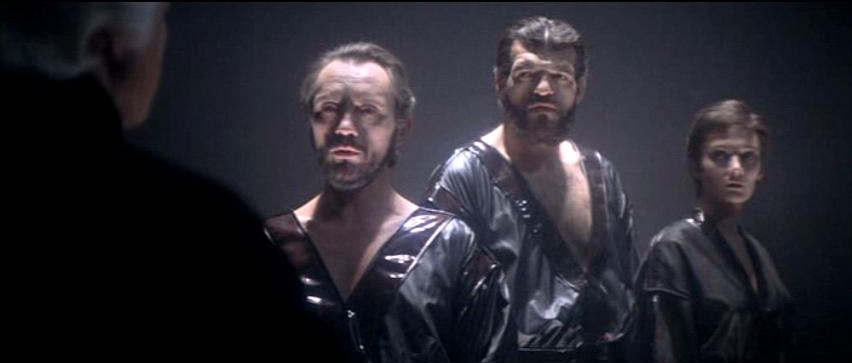
Where was I? Oh, yeah, 1978. And of course, one can't watch Superman without discussing Superman II--flawed in execution, but we have all forgiven those lapses because of the three rogue Kryptonians and the ensuing fight between them and Superman. Awesome in every respect, and it's in that fight that we are shown something fundamental about the character. To quote General Zod, "He cares. He cares about these humans." Of course, we knew it already, but for the more obtuse members of the audience (hey, it was the 1980s), this is a core concept for Superman.

My first betrayal as an adolescent geek.
This movie was supposed to be better
than the first two, and yet, it wasn't.
At all. In any way, shape, or form. I
personally think one of the many
reasons was the attempt to try and
marry more of the comic book stuff
into the movie. That's where the
silly tone come from, largely.

Granted, being a member of Generation X also means we have to at least acknowledge Superman III. No one asked for this, and I'm still not sure why we got it. Or the fourth movie, which was even more terrible. But it doesn't matter, because in 1988, something interesting happened: Superman's 50th Birthday.  And our birthday present from DC comics was John Byrne's Man of Steel.

This was the first public acknowledgement of a character revamp for Superman. Byrne was, at the time, a respected and popular comic book writer and artist, and this was an extremely high profile job. He was tasked with cleaning out the Superman closet. Get rid of super-ventriloquism and freeze breath and all of the other goof-ass things that made Superman such a buffoon over the years, and give us a Superman for the modern era.

Well, the first place Byrne went to was the Superman movie. Yeah. He pulled a lot from the film in terms of tone, in terms of scale, and in terms of sensibilities. This was before Tim Burton's creative interpretation of Batman, remember, and so to remake a super hero as iconic as Superman was a bold move, but it was one that worked. Goofy Luthor was no more. Now he was a wealthy industrialist with vast resources, pretty much the image of Luthor that everyone since then has grown up with. Byrne also scaled Superman's powers way down. Way down. He was still the most powerful guy around, but no more of this planet-juggling strength, or flying so fast that he could break the time barrier. That was crucial, because, otherwise, how do you write for a character that can do anything? That's where Kryptonite came from in the first place, after all. They needed it for the radio program because the writers couldn't envision a scenario that Superman couldn't punch, fly, or otherwise demolish his way out of. They had to give him something to weaken him.

Everything in this movie was a love note
to Chris Reeve's Superman. The only prob-
lem was this: we didn't need a love note.
We knew it was great, and this re-tread over
familiar ground wasn't necessary.
But you probably know all of this, right? After all, you're like me, or mostly so. We have a lot of shared experiences in common, especially if you're around my age, give or take a few years. So, we're going to skip ahead to 2006 and the spectacular failure that was Superman Returns.

This is a film that should have worked. The special effects got a much needed upgrade. We saw a bullet bounce off of Supeman's eyeball, for crying out loud. That was very cool.They went back to what had by then become sacred source material: the original Richard Donner directed Superman: The Movie and Superman II. They did something we've all been doing for decades: they pretended that the third and fourth Superman movies never happened. So why did it fail?

I think the answer lies in why Man of Steel is currently doing so well. That Superman was our Superman (meaning, my generation), and while we are certainly all movie-goers, we're just a fraction of the total audience. There were more people who considered those movies "old" and "classic" and less charitably, "dated" than there were us. And you know what? They were right. In the same way that I watched George Reeves playing Superman in the 1950s and feeling like I wasn't in on the joke, Brandon Routh's earnest Superman failed because it wasn't the Superman for Generation Y (or, if you prefer, the Millennials).

It has been argued that comics are a reflection of their time period, and they mirror the concerns and the ideals of each new generation that discovers them. I agree with that, for the most part, but I think there is an exception found in Superman. I think we tend to re-invent Superman, not as a reflection of the zeitgeist, but rather as a reaction to it. We remake Superman into what we need at the time. I can't think of any other super hero or fictional character from popular culture where this is so. It seems to be unique to Superman. But when you think about it, we can chart Superman by the decade and see that he's either a call or a response to each era.

There's a lot to say about Lois chasing
after Superman, trying to get him to
settle down, have kids, etc. Was it
a reaction to the soldiers coming
home from World War II? Or was
it aimed at the young girls who wanted
romance with a modern day Prince
Charming from another world...?

When Superman first appeared, he was a populist reaction to the people working outside of the system, taking unfair advantage, etc. It was the late 1930's and the Great Depression was still coloring and shaping politics and culture. Superman of 1940's  became an ideal, and not just of the "ubermensch" variety, either. Truth, Justice, and the American way were the order of the day, and Superman's marching orders were very clear: lead the troops.

By the 1950's (and well into the 1960's, too), Superman's biggest adversary was Lois Lane and the threat of both exposing his secret identity, and putting a wedding ring on his finger. Most of Superman's other adversaries took on an otherworldly aspect, which makes a certain kind of sense in the uncertain times of the 1950s. The threat of exposure for Clark Kent also has an eerie resonance when you consider the Communist witchhunts of the mid-1950's. Superman gets even nuttier in the 1960's--lots of changes, don't you know. Red kryponite was a perfect plot device for these writers who were scraping the barrel to make Kal-El entertaining month after month.

By the 1970's, the comics were going nowhere, but the Superman movie gave us a breath of fresh air. Right in the middle of disco, jaded politics, and a new, emerging kind of cynicism that certainly colored my generation's participation in politics, here's this fresh-faced guy who never lies, believes in the goodness of other people, and is incorruptible. It certainly gave me hope, and I was only 9 at the time.

And so on, and so on, for generation after generation, while bored editors decide to take a character "back to their roots," only Superman gets updated to reflect the times in which he is operating.

If that's my premise, then, it would stand to reason that Man of Steel is Generation Y's Superman--the Superman they need right now. Certainly box office numbers would bear that out. Apart from Rotten Tomatoes, and of course, Mark Waid's spot-on breakdown of the movie, I haven't kept up with the Internet chatter. I'm willing to bet that everyone over the age of 35 had problems with the film, and everyone under the age of 30 is sneering at us old men in our black socks, standing on our collective porch, waving our canes at the punks.

Tom Welling played young Clark Kent for
ten seasons on Smallville, and they also
ran a super team's worth of similarly hot
teen heroes we were supposed to recognize
like Cyborg and Aquaman. Big deal. But I
ask you: can that kid smolder, or can that
kid smolder? Heat vision, indeed...
I can't argue with any of it, really. It's not the movie for us. We had our movie, some 25 years ago. It still gives me goose bumps to watch it. The sweeping soundtrack, the first time Clark yanks open his shirt to reveal the iconic S on the chest, the wry asides that sort of snub their noses at the older generation, like when Clark's looking for a place to change and he stops next to a payphone, looks it up and down, and runs on. No one under the age of 40 gets that Superman changing in a phone booth was, like, an established thing for decades. That's my Superman movie, and I can still watch it, but let's be clear: it's pure nostalgia that fuels my feelings for the movie. I haven't felt a connection with Superman in years.

They've tried, God bless 'em, they really have. Lois & Clark: the Adventures of Superman was a joke, it really was. As much as I liked the cast, they just didn't work for me. Why even make a soap opera about the most powerful man on the planet if all he's going to do is untie Lois Lane every week? Same thing with Smallville. I know many of you liked the series, but more teen angst I just do not need. I suspect the audience for these shows were starved of a certain kind of super heroic entertainment that DC was (and largely still is) incapable of producing on a large scale. Only their animated series scratched any kind of itch, and that we completely due to Paul Dini and Bruce Timm, and I think we can all agree on that.

The Mego Superman Action Figure, one
of the greatest toy lines of all time. The
reason: scale! When everything was the
same scale, the mash-ups that occurred
were inevitable. I still loved using the
Enterprise Bridge Set to transform Mr.
Spock into a gorilla soldier from Planet
of the Apes. It was a simpler time...


We can also agree that while the Superman (and other) cartoons were great, they weren't being watched by all of the people who turned up to see Man of Steel this weekend. I think it's fair to say that the audience in the theater was largely made up of people who knew about Superman, but didn't know Superman the way we know Superman. They know the broad strokes, the popular culture commonalities that exist out there in a communal state, ready to be accessed any time a rock band needs a quick metaphor or a sketch comedy troupe needs a topical skit. When it comes to defining a character like Superman, you need a movie to reach the most people, and in Man of Steel, Generation Y got their man.

But what did they get, exactly? I'll defer to Mark Waid's commentary, for the most part. I think he covered the ground pretty well. Truthfully, I'm still struggling with whether or not I liked the movie enough to say I liked it. I think for most of my writerly friends, we called it as soon as we heard that Zach Snyder was helming the project--we all said that it would be pretty, but ultimately devoid of heart, and that assessment is accurate. Snyder's use of the CGI medium has certainly matured, and he's finally gotten rid of that slow-mo-fast-mo-slow-mo explosion shot that has dogged him since his first film. He has replaced that shot with a hand-held camcorder that is supposed to lend immediacy to the scenes, but only makes me want to pop a handful of dramamine.

One of the best comics of the 1970's by any
definition. Art by Neal Adams.

The movie was well-cast, except for Amy Adams, who is wasted in her role as Lois Lane. It's not her fault; it's just that the part isn't there. There's almost no characterization for her. The only reason we buy her as Lois Lane is because we are told to. Michael Shannon is tremendous as the very believable General Zod who is not evil, merely villainous. At least, initially. I liked everyone else in the movie, even the leading man, Henry Cavill, who certainly looks the part, even if he had very little to do as an actor.

For me, the biggest disappointment and I think a failing of the film is this: I didn't connect with Superman, or Clark Kent. Not at all. Not until the death of Jonathan Kent did I feel even a pang of sympathy for him. But that's all right, because Superman doesn't seem to care for us. See Mark Waid, above.

I'm not going to complain about the changes to the canon: Lois figures out Clark's secret identity pretty quickly, and with little fanfare. That's knocking out a major chunk of iconography, right there. I guess we're going to just trust that the reporter with the Pulitzer is going to sit on this one story, because of how it all sounds, when you add it up. The "strange visitor from another world..." part, that is. We are apparently at ground zero, in a world without super heroes (even though we get a couple of shots of LexCorp trucks). So, when Superman reveals himself (in costume, as opposed to moving from town to town, helping with disasters and bullies before moving on down the road, like David Banner from the Incredible Hulk TV show), it should be a big deal, right?

Alex Ross, the Neal Adams of the 1990's, gave Superman that
timeless quality that we all sorta took for granted.  All of his
lush paintings seemed to recapture and redefine those essential
elements of the iconic super heroes. But Ross' reworkings
were not re-imaginings so much as the ability to hone in on
the nostalgic elements that everyone keyed off of. Ross'
Superman, then, was more what we thought he SHOULD
have looked like all along.
I never got that sense of gravitas, of awe, of wonder, and of joy. It's absent from this film. And the thirty minutes of disaster porn that makes up the last two reels of the film only call to mind what happened on 9/11 and how I felt about it then. That's clearly the vibe Snyder was shooting for, and he scored.  In fact, I did get anxious when I saw all of the buildings coming down, literally, like rows of dominos, and do you know what my reaction was? "Superman will save them." But he didn't. He just didn't. I'm on record as being the guy who says its okay to rework comic book characters for the big screen provided you get the core of the character right. This isn't mechanical versus natural web shooters we're talking about, here. It's a fundamental re-write of the core value system of a seventy five year old character that is one of the most recognizable characters on the entire planet.

This promotional image should tell you everything
you need to know about the Lois & Clark TV show.
And yet, I didn't know how good I had it...
I think I've just made up my mind about the movie. This is bullshit. Kudos to DC; you may just have jump-started your slow march to a Justice League movie. But if this is how you start the journey, it's going to be more like the Bataan Death March.

In addition to the wanton destruction of Metropolis, the whole thing felt as if it were free of consequences. I kept expecting there to be a scene like in Superman II where he begs the rogue Kryptonians to leave the civilians alone. I never got that moment. It was not just weird, it was off-putting. I would never have guessed that the part of the character most in need of a revamp was his heart and his empathy.

That's not to say that I didn't enjoy the visuals. They are sumptuous, especially on Krypton. And the Superman-Zod fight is one of the best super hero battles I've ever seen on film, ever. When the movie works, it works as grand spectacle, even as Snyder is pulling images from seventy five years of memorable scenes. The oil tanker wall catch, for example, is lifted straight out of the Fleischer cartoon where Superman catches a falling building. But that's not a problem, as far as I'm concerned. Part of the fun of a movie like this is throwing those iconic moments into the film for more resonance. Man of Steel needed all the help it could get, I tell you what. As I watched it, waiting for my heart to start caring about what I was seeing, I reflected on this version of Superman. This cold, pale, conflicted, Superman, who is told to protect the secret of his super powers because basically, people are a cowardly, superstitious lot. Wow.

The days of the Super Friends are over.
These cartoons are now a cultural
artifact unto themselves, and not in a
good way. Especially the Wendy and
Marvin years.
I've heard some people are laying the film's dark tone at the feet of producer Christopher Nolan, who of course, gave us his recent Batman trilogy, to much critical acclaim. Maybe. Maybe not. Just as both characters are orphaned by tragedy, the point of Superman and Batman as a study in contrasts is that they take different paths. Batman embraces the dark. Superman, the light. But the light that this Superman embraces is a post-9/11 sunrise, where authority figures have to make difficult decisions and calculate the value of one life for many, and also have to ponder just how dirty do their hands have to get in order to accomplish their goals. How else do you explain Superman snapping Zod's neck at the end of the film?

There's no Phantom Zone reprieve, there's no re-wiring the molecule chamber to take their powers away...it's just a difficult choice that does clearly cause Superman great anguish, but doesn't prevent him from pulling the trigger. Granted, we've seen this before in--wait for it--the comic books. Remember those? John Byrne killed the Phantom Zone renegades in his stewardship of the Superman character. And it was a big, huge deal. It impacted Superman negatively, and spun out into a story line that took years to resolve. It fragmented Superman's core identity and brought about a split personality! THAT'S how big a deal it was. Because Superman doesn't kill, you see. Well, not until the end of the 1980's, that is. I'm sure there's come cultural relevance there, but I'm too exhausted to seek it out right now.  But after Superman snaps Zod's neck, and cries out, we go straight to a shot of him smirking at the General and telling him, "you're not the boss of me." So, yeah, extreme actions carry very little consequences whenever they are used to stop American deaths. I wonder, out loud, if there are any parallels to our current political climate that could be used as a metaphor here? But I digress. As thirty minutes of disaster porn cascaded over me, rendering me numb and cold, I could see that the film was leading up to this final confrontation, and I felt like I was watching Seven all over again. Snyder gives us the ending we're asking for, but it doesn't make anyone feel any better.

I bought this treasury edition with my own
money. And it was so very worth it.
Check that. It didn't make me (or Mark Waid) feel any better. Everyone else, from the looks of the box office and the comments I've seen, loved it. The critics remain unmoved in their lukewarm appraisal of the film, but the rest of the world is happy that Superman has been re-defined and updated into a "real hero." You and I know that this is only good for, what? Ten, fifteen years? And then we'll re-define Superman again, and that'll be the flavor of the month. I know now that it had to happen. I'm just not very happy with what it says about us as a people right now. Then again, there's this website, something that could only have come about in the Millennial Age; a post-modern, ironic deconstruction of established popular culture. Ah, well, we have to tear down the old idols before we can put up new ones, don't we?

If you'd rather hear me waxing positive about Superman, you can download and listen to the recent RevolutionSF Roundtable Podcasts wherein I talked all about what I liked about the character with my fellow round tablers. It's a lively show, especially when I start making fun of Doctor Who. Give it a listen, won't you? Part 1 is here and Part 2 is here.

UPDATE: 
David Goyer answers a lot of questions and concerns in this letter to Bleeding Cool. I appreciate him breaking radio silence, and he does seem to address and confirm a couple of points I made in the post above, but he seems to be trading "heroic" for "realistic" as adjectives and I don't think I buy that. Not quite. One of the best scenes in The Avengers was the scene where Cap saved the people in the bank. It's a standout scene in the big battle, and it's full of Kirby-esque dynamism that speaks directly to Cap's character in every way. You can't tell me that in thirty minutes of disaster porn, you couldn't tip in two minutes worth of scenes where young, inexperienced Clark Kent is saving lives--you know, like the one he couldn't save, his father's...? Did I miss a piece of motivation, there? One second of a man flying out of a window of a building that Superman destroyed--he looks down, and sees him falling, and their eyes lock--and then we cut to a one second shot of Jonathan Kent with his hand up, the tornado swallowing him, young Clark screaming--and then we're back in the present day, and Superman's mind is made up: never again! His eyes darken, his jaw sets, and he swoops down and plucks the man out of the sky and lands, only to immediately leap into the air again.

The man watches him go, crying, and laughing.

Don't tell me there wasn't room for that in the movie. I don't believe it. And if Goyer didn't think to include it, then that's his failing.


Friday, May 10, 2013

"I Had No Idea he was a Racist Douchebag"

We just had a fan quit Robert E. Howard studies today. This person, who identified themselves only as "Red Dragon" on Facebook, announced their intention with that above line, and followed it with a short checklist of what was to come next. All of their books were to be binned, and they would unsubscribe from all of the REH lists that they were on. "I will seriously have sold my conan stuff by tomorrow and will never read another thing by him again," Red Dragon posted. Older, wiser heads attempted to prevail, but Red Dragon was presumably already long gone.

Now, I don't know anything about this person other than the fact that their picture on FaceBook was that of a woman, with blonde hair, maybe twenty-five to thirty. I make no assumptions as to if Red Dragon was truly a woman or a G.I.R.L. (Guy in Real Life). This is the Internet. Anything is possible.

But I do want to use this example to point out something: Here was a person, attracted to the writings of a long-dead author, so much so that they bought a pile of books, read them all, and jumped online and joined a number of fan groups, Facebook pages, and participated in discussions. I'd consider that to be fairly typical fan behavior, certainly well within the bounds of reason.

I don't know what Red Dragon ran across that made this sudden change happen--the popular supposition is that they read part of a discussion about a story Howard wrote when he was still a teenager called "The Last White Man." It's a bit of unpublished juvenilia about, well, you can guess what it's about. It was written in response to a letter penned by one of Howard's close, personal friends--a person who was, himself, a member of an organization that was active in the persecution of African-Americans. The story was not published in Howard's lifetime, and in fact, the only reason it was published at all was for the sake of completeness. Another gem from Howard's school days was "A Boy, A Beehive, and a Chinaman." So, you know, that's the thinking of a young Robert E. Howard, right there.

I want to say something, but it won't change anyone's mind. I'm a native Texan, and I'm over forty. This makes me the enemy in the eyes of the younger generations. But I want to walk carefully through this anyway, because it's taken me a while to get to this particular place. Maybe my journey will be of some use to someone out there. Maybe.

I think the thing that bothers me the most about Red Dragon's sudden reversal was that there was no attempt to square the things that originally attracted Red Dragon to Howard's writing, so much so that they would seek out other like-minded people, and the story in question that they heard about in an online conversation. Red Dragon basically threw Howard under the bus with the revelation that he wrote "the Last White Man." Granted, it's not Howard's finest hour, and I wouldn't recommend the story to, well, anyone--and I say that having written charitably a half million words on Howard in the last fifteen years. But this was clearly not something that Red Dragon had picked up on prior to their  declaration, and for one very likely reason: that's not the takeaway message from Robert E. Howard's work.

Oh, the Internet will tell you differently, to be sure. There are a few blog posts out there by folks who started reading Conan and were drawn up short by this monstrous, over-arching racism--or words to that effect. And then they'd blog about what a terrible person Robert E. Howard is. As if he was the first person in fantasy to write about different cultures in an insensitive way. Conan, Solomon Kane, and other stories about other characters--all racist. It's right there. It's repulsive. They just couldn't get through it.

I'm not going to defend the position that Howard isn't a racist. Partially because I think the word "racist" has come to mean something very different than what Funk and Wagnalls will tell you. I think "racist" in modern day language is another word for "outcast" or "pariah." It's verbal leprosy. Someone who is a racist is someone to be shunned, for fear that their disease, their poison, seep into your ears and eyes and rot your brain and turn you into one of them. This notion of the power of speech, or the printed word, is a new thing, I think, and certainly bears discussion somewhere else. But more to the point, "racist" implies that there's an active component in place; a willful need to infect others in a way that is impossible to defend against, like a zombie pathogen.

I won't lambast the younger generation for a lack of critical thinking skills, because that would be showing my age. But I will lambast the generation ahead of me for setting up this idea of "Political Correctness" that has led to a kind of intolerance for anything that is deemed offensive or hurtful to another person, regardless of context, meaning, and intent. Enough about that. We were talking about Robert E. Howard.

Here are some facts: Howard employed language which was well within societal norms in the 1920s and 1930s, but is certainly not appropriate now. Howard wrote about a variety of races and peoples and ethnicities, mostly in his fantasy stories, but also in a number of historical adventures. He used language that was stereotypical, and occasionally derogatory, when talking about these people. Sometimes, they were heroes. Sometimes they were sympathetically portrayed. Sometimes they were the bad guys. In a few cases, Howard wrote recurring characters of color. These characters and descriptions were based almost entirely on what he read in the pulps, and what books he was able to get his hands on. Some of those books were ten, fifteen, twenty years out of date. Other books were fictions by Rudyard Kipling, Mark Twain, and other classic authors. Many of the pulps he read features stories set in other countries and time periods, and these pulps also published articles and letters about foreign countries and conflicts. So, for a guy who was landlocked in Central Texas, he did the best he could do.

The other reason why I won't defend the charge of racism is because, in the context of his time and place, Howard was, in fact, a racist. And so was your grandfather. And your great grandfather. And Rudyard Kipling. And Joseph Conrad. And Jack London. And Woodrow Wilson. And just about anyone born prior to 1960 in America. Institutional racism was in full swing, especially in Texas. Separate bathrooms, lynchings, you name it. It was all out there, if not in the wide open, at least tacitly understood. There are just some places you don't go; there are just some people you don't talk to. Granted, every community was different, but by and large, people of color who were a part of a mostly white community were included as exceptions rather than as a rule.  This was the world your grandparents grew up in, by the way. Yes, them, too.

Did Howard know any black people? Sure, a few. He knew a few Hispanics, a Jewish man, and saw and observed Italians, Chinese, and other immigrants in his travels to places like New Orleans and San Antonio. Some of his descriptions were drawn whole cloth from his experiences, or from letters he wrote to correspondents like H.P. Lovecraft, who was himself a xenophobe and a monstrous bigot.

None of this was known to me when I first discovered Robert E. Howard's Conan, coming out of comics and Dungeons and Dragons. There were some folks in the Conan stories who were freed slaves, and there were black, yellow, olive, dusky, and fair skinned people in Conan's world, and they were good, or bad, or rulers, or cowardly dogs, depending on which side of Conan's sword they were on. You can call it white blindness on my part, but I never read Howard's descriptions of ebony skinned cannibals and assumed that Howard was talking about all black men. In fact, it's pretty clear in the story that it's this one city and not everyone in the region. I always liked it when N'Longa, the witch doctor, showed up in the Solomon Kane stories. He was a very different person--on purpose--from straightlaced Puritan Solomon Kane himself. N'Longa gives Kane a Ju-Ju staff, which proves to be a useful magic item in Kane's arsenal against the dark forces. This is heathen magic that the Puritan supposedly has no truck with, and yet, they formed an alliance against monsters.

This was a common pairing in Howard's stories, from Kull and Brule the Spear-Slayer to the unlikely friendships found in Howard's historical tales of the Crusades, and the El Borak stories. A white, if not implicitly W.A.S.P. man, befriends or joins forces with a non-white character for fortune, glory, survival, or friendship. Sometimes it's the end result. Sometimes it's the motive for the story.

Yes, the Africans are "wooly headed." Yes, the Shemite has a hooked nose. I know, I know. That's bad. It's a sloppy shortcut. I won't defend it. Mostly.

It's stereotypical. It's stereotyping. And while it's today considered, well, stereotyping, back in all of popular culture--books, magazines, newspapers, the radio, comics--every media in existence prior to 1945, this was accepted. It was okay, even encouraged, to make these short, sharp descriptors and even judgements about people of other ethnicities than your own. All Irish were hot tempered fighters. All Jewish people were thrifty and shrewd with money. All Italians were overly amorous.  All French people were snobs. All Swedes were big and stupid. These weren't seen as detriments, but rather simplified ways of communicating a set of cultural values and general set of traits at a time when immigration had literally flooded America with millions of people from all over the world. These folks were trying to fit in, and any chance they had to "become Americans," they took. Right up to and including laughing at themselves. Stereotyping was employed by vitually every comedian from the age of Vaudeville up through the rise of radio and later, Television. Many of these comedians moved from medium to medium with their same act, nearly unchanged for forty years.

Jack Benny, a legendary Jewish comedian (who employed a black piano player named Rochester, who spoke in a gruff parody of southern black speech himself) had a very famous bit from his radio show. He's held up at gunpoint by a mugger one evening, who says, "Your money or your life." After a pause, the gunman says, "Well?" and Benny, in his trademark exasperated fashion, says "I'm thinking it over!" One of the recordings online has the audience laughing as soon as the mugger says "Your money or your life." They know Jack Benny, and it's already funny to think that he'd be put in a situation where he has to choose something he values more than his wealth. Stereotypical Jewish behavior, rewritten as a very funny one-liner.

So, I'll cop to it on my part: I never saw what others saw in some of Howard's stories. Not until I got to "Pigeons From Hell" as a teenager, when I first encountered the word "nigger" in the story, did I stop and think about what was going on. After all, that was a word that was forbidden in my house. Well, unless my grandfather said it. Or my father. But anyway. I had to suddenly walk through the time and place of the story and ask myself, "Would a sheriff use that word in casual conversation? In 1936?" And of course, the answer was yes. Yes, he would have. Doesn't mean it's not an ugly word, and while it was certainly a stumbling block, I picked the narrative back up and soldiered on.

The stereotyping was lost on me in the Conan stories. No one likes anyone in the Conan stories. Each country is at war with other countries. People from the Southern kingdoms hate people from the Northern kingdoms. No one has a flattering thing to say about anyone. But that's not the takeaway point of Conan.

N'Longa talks much like the stereotypical educated native to Solomon Kane, and he's definitely what Spike Lee calls a "Magical Negro" in literal, if not figurative, terms. But that's not the takeaway point of Solomon Kane.

Reading "The Ghost of Tom Molyneaux," it's obvious that Ace Jessel speaks in a dialect lifted straight from Huckleberry Finn, if not Uncle Tom's Cabin. It's uncomfortable to read, but that's not the takeaway from any of the boxing stories Howard wrote.

Howard wrote about conflict, often between two cultures, and the sometimes exceptional men that arise from a life built around conflict. Roman or Pict, Moor or Turk, Gael or Dane, and yeah, even White or Black, Howard's message was about overcoming impossible odds, never giving up, never admitting defeat. Howard wrote about the struggle between good and evil, right and wrong, morality and scruples. He wrote about the character of masculinity--in other words, what makes a man. Interestingly, he also wrote a few stories about what makes a woman in a man's world, too. He wrote about the differences between civilization and barbarism and how blurred the line between them sometimes was.

That's what I see when I read Robert E. Howard's work, laid bare. And I know I'm not the only one because he's got millions of fans all over the world who see pretty much the same things. This in no way excuses the stereotyping, or some of the things he said to his friends. But as a reader with critical faculties in place, I think considering when and where he did his writing, it more than mitigates it.

Time and place have to mitigate content. Otherwise, we couldn't read Joseph Conrad, Jack London, Shakespeare, Mark Twain, or anyone else born before 1945. But, then again, there's a copy of Huckleberry Finn floating around right now with nary and N-Bomb in sight, so what do I know?

This is new thinking. I'm pretty sure the kids these days (those in high school and college) aren't willingly reading Conrad, London, Hemingway, or any of the other old, dead, white-guy authors that were "racist douchebags." I don't know when that particular attitude of condemnation for anything that doesn't conform to ones' own internal barometer of taste sprang up, but I suspect it's got something to do with the inflated sense of entitlement and the utter lack of empathy that seems to be all the rage amongst today's hard-wired mall rats.

In the end, there is only the author's work, and the reader's relationship to it. I'm capable of cutting authors some slack when I read their dated works, but then again, I'm a doughy, pasty white guy. Technically, I'm "part of the problem." If you, as a reader, find something so objectionable in a book that it makes you fly into a rage, well, that's your journey, and who am I to say different? I've read some singularly distasteful things in my life--one that springs instantly to mind involves a rape that takes place in a Philip Jose Farmer novel called Lord Tyger. It made me uncomfortable. But after reading it, it didn't turn me into a rapist.

I've read books where the characters are utterly despicable, and say horrible things to and about other characters in the book. Reading those things brought out a number of reactions in me, but they didn't make me into a despicable person. They were just words. Fictional stories, full of words, at that. If they brought out an emotion from me, then the story did its job. Is that not the primary function of art?

Maybe instead of trying to bring the next generation of fans to Robert E. Howard, we need to be waving them off. If reading a word in a story is going to cause them to freak out and rage-quit the author, then that's more flailing about that we don't need. In the past, we've tried to put our best foot forward. We've tried to show critical examinations from both sides of a particular issue. If none of that matters because, well, he was a "racist douchebag," then why waste of of my time and effort? How can someone learn anything knew when they know everything already?

I don't have any answers. If you've read to the end of this very long post, and feel like discussing, have at it.


Tuesday, May 7, 2013

Ray Harryhausen Is the Father of us All

Ray Harryhausen passed away today at the age of 92. He was, in so many ways, the architect of everything that is great about fantasy movies. If you are a fan of any big, well-realized spectacle of a fantasy film from The Lord of the Rings on down, you owe a debt of gratitude to Ray Harryhausen and his movies, because he set the template, wrote the style sheet on how these movies would be filmed and executed. There isn't a special effects man in the world who hasn't heard of Harryhausen and in some way benefited from watching his work. But Ray was more than just a special effects man--arguably a pioneer in the field of stop motion photography--but he was also an incredible, talented, visionary artist who spent decades breathing life into the inanimate. He was a wizard, a sorcerer, and we have all lost something singular and profound with his passing.

Ray's inspiration for creating movie magic was seeing King Kong as a boy. He told the story often, as famous people who are asked the same questions constantly are wont to do.  It's a good story, and a charming one, but it doesn't really get across the sheer chutzpah of what he did next. He started doing his own stop-motion animation in his garage and when he had enough to show someone, he sought out Willis O'Brien, the man who created the stop-motion effects for King Kong. O'Brien hired Harryhausen as an assistant on the movie, Mighty Joe Young, where he wound up doing much of the work.

O'Brien taught Ray all that he knew, but it was Ray who took that knowledge and elevated stop motion to an art form. His ability to sketch and sculpt served him well as he created better articulated puppets to work with. But whereas O'Brien helped Ray with some technical pointers, it was Ray who began to give his sophisticated action figures individual personalities, specific body language, and emotional arcs. The fantastic creatures didn't just move, anymore; they acted. They came alive. Each one different, no two alike. The cyclops in The Seventh Voyage of Sindbad reacts with confusion when he encounters the sailors. Gwangi the Allosaur plays with its prey. The baboon prince in Sindbad and the Eye of the Tiger is both a monkey and a man in equal measure. Every Ray Harryhausen fan has their favorite creation. But no one disputes Ray's crowning achievement, his technical triumph, in Jason and the Argonauts.

The film's climax has a skeleton horde rising out of the ground to destroy Jason and his crew. The scene is breathtaking in execution, and mind-boggling in its complexity. Ray was in charge of animating five or six skeletons at a time, and each of them had to move a certain way, in coordination with the actor's movements (filmed on location months before), and each of them constantly in motion. You have to think about what that entails:

Skeleton #1: attacking Jason. Head moving forward, left arm moving to block with shield, right arm recovering to swing, left foot back, right foot forward. Mouth closed.

Skeleton #2: attacking sailor. Head moving back. Right arm back. Left arm connecting with sailor's sword. Right foot up, moving to kick the sailor. Left foot planted.

Skeleton #3: Running forward to battle. Head forward, left leg up, right leg down, right arm back, left leg forward.

Skeleton #4: On ground. Head is down. Right arm on forehead, dizzy. Left arm on ground. Sword still in hand. Torso twisting to right. Left leg bent, knee up. Right leg straight out, swinging left.

Skeleton #5: attacking sailor: Head down. Right hand high, sword in hand. Left arm up, shield is connecting with sailor's sword. Body is moving back from the force of the blow. Right leg stepping backward, left leg planted.

Skeleton #6: Climbing onto platform.  Left leg is up, right leg bent and backward.Arms braced on platform at the elbows. Head forward, Mouth open in a scream. Starting to close.

Annnnd, click. That's one frame of film. Now, imagine having to do that for twenty-four frames of film. That's one second of the scene. But don't take my word for it. Watch the entire sequence for yourself.

Granted, you are spoiling the movie for yourself if you haven't seen it, but if you're reading this blog, I'm betting you have, and multiple times. I still smile and gasp when I watch this sequence. The little touches he put into the sequences, like the beheading, and the way the skeletons hover and wait for the sailor to fall before leaving him for another target. Again, there's that personality at work in everything Ray did. Some days were so intensive on this final scene that he was only able to capture three frames of film in one day. An eighth of a movie second. He did that for four and a half months, in a room, by himself, with no assistance from anyone else.

That's an artist at work, folks.

That scene alone is responsible for more people getting into stop-motion than anything else. Phil Tippett is an unapologetic fan of Ray's and Tippett did the stop motion effects on the Star Wars trilogy. If you thought the tauntauns were cool, Ray was their spiritual godfather. Later, when Jurassic Park was in development, Phil was brought in to work with the computer animators to help bridge the gap between stop-motion and computer animation.  Dave Allen and Jim Danforth were also Harryhausen disciples and they produced a lot of commercial work whenever Ray was locked in his room, working on the next movie. When Dinosaurs Ruled the Earth, Q, Caveman, Dragonslayer, and so many other (and some would say lesser) movies and TV shows (remember Land of the Lost?) were created by people who were inspired by Harryhausen. Here's a Volkswagon ad that Allen produced for TV starring a familiar face:


I got to meet Ray twice in my life. The first time was during one of the late, lamented Dallas Fantasy Fairs in the Late 1980s and early 1990s. Ray was a special guest and I was over the moon at getting to meet him. I'll never forget sitting in a jam-packed conference room with maybe a hundred other people waiting for his question and answer session. The moderator stood up and said, "Ray Harryhausen needs no introduction. Instead, here's a brief reminder of why we're all here today." The lights dimmed and then a montage of scenes from Ray's various films, all of them key scenes, all of them evoking gasps and cheers of recognition from the audience. Of course, the montage ended with the skeleton fight. Of course it did! And with that, the video ended, frozen on one of the scowling skeletons' faces. Everyone surged up and gave Ray a standing ovation to thunderous applause, and it was one of the first times I thought, "Okay, I'm not alone, here. Other people get this stuff, too!"

Years later, while working at BookPeople in Austin, I got my second chance. Ray had written a couple of books looking back on his career, with tons of artwork, sketches, behind the scenes photos and more. We were having a book signing for him at the Alamo Draft House, where Ray would introduce the movie that inspired him, King Kong, and then sign copies of his book. It was probably the best signing I ever worked on. King Kong and Ray Harryhausen. What could be better?

Even at his age, Ray was a trooper and gamely signed every book that showed up, along with some other oddities. I was again touched by the crowd; sure, there were some old timers there, but there were also a lot of young dads with their kids--and it was the kids who were there to see him. That's the power of those movies. That's the magic of Ray. And he was nice, gracious, charming, and personally thanked everyone who thanked him back. I'm so glad that Hollywood awarded him a lifetime achievement award while he was alive to appreciate it.

Now everything is computer-generated, and at its best, it's amazing, and I really believe that. But I think it's interesting to note that the most amazing stuff now is essentially modeling faces directly from human actors. There's a reason for this: modern special effects people--to an extent--don't have the skill set that Ray had. They don't take acting lessons to try and understand character motivation, or light and film their own sets, or do modeling in three dimensions. I'm not talking about the effects studios like ILM and Weta. They have, as a hive-mind, people who DO still do that, and do it well. I'm mostly talking about the guys who render for a living; sitting at a computer every day, working on whatever three or four second shot has hit their desk that morning, doesn't leave a lot of room for wondering what the dragon's motivation is. Modern filmmaking doesn't work that way. There's no room for artists, not when there's all of these shots to process. And so, we've lost a step.

In the passing of Ray Harryhausen, we've lost the man who took that first step.

Thank you, Ray, for the creativity, the artistry, for the hard work. Thanks for all of it.

Rest in peace.


Thursday, April 18, 2013

Finn's Six Shooter, Volume 1

Six Bite-Sized commentaries on what's going on in and around our strange world. Starting at the top of the list:

1. Superman's 75th Birthday.
Even though the character remains caught in an endless tug-of-war battle between the heirs of the original creators and the faceless megacorporation that has controlled the intellectual property for years, the fact remains that Superman is still considered our first modern super hero and has become synonymously tied to the best qualities of the American people. I hope that the movie does well later this year, but I'm not holding my breath. And while he's not my first, nor my favorite, Big Name Super Hero, at his best, when the stories are at their greatest, he's hard to beat. We need an example, now more than ever, of an ideal to strive for. In the arena of popular culture, Supes is still at the top of the list. Happy Birthday, Big Guy.

2. The Boston Bombing
I'm extremely disheartened by what has happened, and I officially take back every bad thing I ever said about Boston. No one deserves this. No one. And as its been pointed out by many others already: boy, did you guys pick the wrong city to mess with. I am very impressed with the 24 hour news networks' restrained and cautious coverage of the situation--what a refreshing change of pace. They figured out really early on that no one wanted any politicizing--they just wanted facts, information, and data. Maybe they could carry that lesson forward into their day-to-day operations, but--no, that's asking for too much.

3. The West Explosion
It's been very hard to watch the news. I love the town of West. My mother is Czech, and so I'm half-Czech, and while we don't have any family ties to the town, I have a very real spiritual kinship to the place.

4. When Tragedies Strike
A lot of people like to point to the random violences that routinely disrupt civilization and say, "How can a god who loves everyone allow that to happen?" Well, I don't claim to be any kind of religious scholar, but I don't think that's an accurate interpretation of "God's Will." I don't like that phrase, and I don't use it. I really don't like using God to try and rationalize away a tragedy, as if it's okay that houses blew up and people died. It's not okay. It never has been. But I do think this: when people turn around and run back into the blast to pull other folks to safety; when strangers run directly into hospitals to give blood; when people just start cooking food on the side of the road and giving sandwiches and blankets to their neighbors; when first responders charge into buildings knowing that an explosion is coming--there's the love of a higher power, right there--that's the presence of something greater than ourselves. It's that positive energy that we all respond to on a gut-level.

5. TV Round-Up
I'm finally caught up with Mad Men that I'm watching the new season as it's playing out. Wow. This may be the season that jumps the shark. Game of Thrones had better pick up the pace. I'm already starting to get bored. I had a flash-forward of how many TV seasons it would take to get to Book Five--charitably, 10 seasons. And GRRM says he has three books to go. I really don't know if I can hang in there that long. And let me say for the record that while I do find NCIS a wonderfully guilty pleasure, mostly for Mark Harmon, is USA contractually obligated to show the same ten episodes in a row, back to back, in perpetuity? Would it kill them to start with season 1 and just run forward with it?

6. A Personal Note to Every Single Male Gamer Currently Whining About "Fake Girls" and "Rape Culture..."
Hey, Chucklehead,
What the hell is wrong with you? Are you seriously THAT emotionally and socially retarded that you are trying to discourage girls, ladies, and women from playing the same games and reading the same comics as you? DO YOU HAVE ANY IDEA HOW LUCKY YOU ARE? No, you don't, because you're the generation of entitlement and privilege, and you've never had to work for social acceptance. I'm over the age of 40. In high school, if I wanted ANY of my girlfriends to read a comic book, I had to tie them to a chair and pin their eyelids back like in A Clockwork Orange.  And even then, it was a hassle. They didn't get it. They didn't want to. Well, those days are long gone, you little Suburban Imbeciles. Now you've got teenage girls who are--let me make this very clear--MUCH better looking than you, wanting to play games and talk about Spider-Man. Um...what's the problem again? And if you're a game manufacturer having this same issue, do us all a favor and decide to become a man, okay? Men don't rape. Men don't exclude others based on gender. In fact, I'd rather play Halo with Jill rather than Jack. And if you can't see the obvious, and not-so-obvious advantages of having girls in the treehouse, then you are Doing It Wrong and you need to self-segregate, so that the rest of us know who you are. Go over there and sit in your own juices. We'll be over here, having a Game of Thrones discussion with the Babes.
Sincerely, That Guy in GameStop Who Was Giving You the Stink-Eye Earlier Today

Tuesday, March 12, 2013

Raiders of the Lost Ark Made Me This Way...


Over the years, I've tried, unsuccessfully, to explain to folks just how important and influential a film Raiders of the Lost Ark was for me. It dropped into my wheelhouse as I was turning the corner on adolescence, at a time when there was no Internet, no Netflix, no YouTube, none of that crap. If you wanted to know more about any given subject, you had to read about it. In books, or magazines--Thank God for Starlog!

As a 12 year old male, Raiders forever altered my course in ways that I've noted over the years, but until you sit down and start trying to backtrack your influences, you don't realize what a tangled mess it all is. I specifically and deliberately stopped when I got to large topics--either existing interests, or newly discovered interests, as they each lead to other branching charts. That's how I was back then (okay, still am)...when I get interested in something, I want to know everything! So, in the case of Raiders, specifically, I watched the television special about the stuntmen who worked on the film, and I read every interview I could find with Spielberg, Lucas, and Lawrence Kasdan. I read the novelization. I collected magazines, bubble gum cards--anything I could get my hands on that had behind-the-scenes information that I could use to decode the formula of how someone could come up with a modern-day whip wielding archeologist who fought Nazis and played with monkeys. You can see how that would appeal to just about anyone, right?

And don't get me started on the my film theory that Raiders is the first post-modern film--a movie about a type of movie, rather than the movie as genre unto itself. I submit to you that because we had Raiders of the Lost Ark, we also got Kill Bill, Inglorious Basterds, and now Django Unchained. I'll go into it later, one of these days, when I have the time. But it's a great theory and it explains why the first film is so very different from the three sequels, and how that happened.

For decades, I've tried to explain it to people, and they would just nod, politely, and reply, "Well, MY favorite movie is blah-blah-blah." No, you don't GET it, I've thought more about this film and its antecedents and influences than I have any other film including Star Wars.  It's not my favorite movie because, well, I just like it, and stuff. It's a part of my creative DNA in ways that still resonate with me to this day.

Because of RotLA, I created "The Blue Menace Mysteries" courtesy of the Violet Crown Radio Players.  Sam Bowen from Clockwork Storybook owes SO MUCH to Indiana Jones. Every 1930s pulp-era Role-Playing Game session I ever ran was informed by the way Lawrence Kasdan chose to write the screenplay to RotLA.

I made this flowchart so you could really see and understand. It's not my fault I'm like this. Raiders of the Lost Ark made me this way...

Here's the chart at full size. Enjoy! The Chart, Full Sized